Char Chimney

Chimney Starter vs Lighter Fluid: Which Should You Buy?

One is a steel tube you buy once. The other is a bottle you rebuy forever and have to let burn off before the food goes on. Four ways to light charcoal, compared on speed, cost and what ends up in the food.

By Stephen V.Last updated How we pick

Buy the chimney starter. A Weber Rapidfire and a box of paraffin cubes is a one-off purchase that lights charcoal faster, costs nothing to run, and puts nothing in the food. Lighter fluid is the cheaper object and the more expensive habit: you rebuy the bottle forever, and Kingsford’s own instructions require you to wait for the fluid to burn off completely before the food goes anywhere near the coals.

That is the honest headline, and it is worth being precise about why, because the usual version of this argument — “fluid makes food taste of chemicals” — is only half true. Fluid that has fully burned off leaves very little behind. The problem is that it takes time to burn off, nobody can see when it has, and the thing people actually do is put burgers on coals that are still flaming. A chimney removes the judgment call entirely: when the top coals gray over, it is done.

There is a second reason, and it is the one that matters more. Kingsford prints it on its own page: never add lighter fluid to hot or flaming coals. That is the single most dangerous thing people do with a charcoal grill, and it is a temptation that only exists if there is a bottle of fluid on the patio.

Below: four ways to light charcoal, what each one costs to run, and which suits which grill. We own none of this gear and claim no testing — the method figures are Kingsford’s and Weber’s own, cited in Sources.

How this is funded: we earn a commission if you buy through our links, at no extra cost to you. It never changes which gift we recommend, and we’ll tell you when we’d skip one. Full disclosure.

Quick picks

Our shortlist, with the price on every pick. Select a row to jump to the full write-up. We haven’t tested these ourselves — here’s exactly what we do instead.

#ProductBest forPrice
1
Weber Rapidfire Chimney Starter (Standard)

Weber Rapidfire Chimney Starter (Standard)

The chimney starter almost every other one is copying. Two handles, a heat shield on the second one, and enough capacity to fill a 22-inch kettle in a single load of coals.

Best way to light charcoal
$24.99 · View on Amazon

Price as of October 24, 2026. #ad How we’re funded

2
Weber Charcoal Lighter Cubes (96 Count)

Weber Charcoal Lighter Cubes (96 Count)

Paraffin cubes that light with a match and burn long enough to catch charcoal, with none of the fumes or fuel taste of lighter fluid. Ninety-six of them is most of a grilling season.

Best starter to pair with it
$23.96 · View on Amazon

Price as of October 24, 2026. #ad How we’re funded

3
Kingsford Compact Charcoal Chimney Starter

Kingsford Compact Charcoal Chimney Starter

The small-grill answer. A full-size chimney lights far more charcoal than a tabletop or portable grill can hold, and the leftovers just burn out on the patio — this one is sized to the grill.

Best for small and portable grills
$15.99 · View on Amazon

Price as of October 24, 2026. #ad How we’re funded

4
Char-Broil Electric Charcoal Starter

Char-Broil Electric Charcoal Starter

A heating element you bury in the coals and plug in — no chimney, no newspaper, no cubes. It needs an outdoor socket, which is the whole catch, but where there is one it is the least fiddly way to light charcoal.

Best if you would rather not light anything
$12.50 · View on Amazon

Price as of October 24, 2026. #ad How we’re funded

The picks in full

#1Best way to light charcoal

Weber Rapidfire Chimney Starter (Standard)

The chimney starter almost every other one is copying. Two handles, a heat shield on the second one, and enough capacity to fill a 22-inch kettle in a single load of coals.

Why it’s a good gift

  • Second handle with a heat shield makes the pour genuinely controllable
  • Capacity matched to a full-size kettle grill
  • Weber build — the version that tends to outlast the cheap clones

Worth knowing

  • Costs roughly double a supermarket chimney
  • Full-size only — too big for a tabletop grill

Best for: The kettle owner who is still using lighter fluid

Details read from the Amazon listing, last checked August 11, 2026. Prices change; the number above is fetched live.

#2Best starter to pair with it

Weber Charcoal Lighter Cubes (96 Count)

Paraffin cubes that light with a match and burn long enough to catch charcoal, with none of the fumes or fuel taste of lighter fluid. Ninety-six of them is most of a grilling season.

Why it’s a good gift

  • Lights charcoal without lighter fluid or its taste
  • Burns long enough to catch even lump charcoal
  • Ninety-six cubes lasts a season of weekends

Worth knowing

  • A consumable, so it is a stocking filler rather than the main gift
  • Needs a chimney or a coal pile to be useful

Best for: Pairing with a chimney so the gift is complete

Details read from the Amazon listing, last checked August 11, 2026. Prices change; the number above is fetched live.

#3Best for small and portable grills

Kingsford Compact Charcoal Chimney Starter

The small-grill answer. A full-size chimney lights far more charcoal than a tabletop or portable grill can hold, and the leftovers just burn out on the patio — this one is sized to the grill.

Why it’s a good gift

  • Sized so a full load matches a small grill
  • Cheapest way into chimney lighting
  • Stores in a fraction of the space of a full-size unit

Worth knowing

  • Too small for a 22-inch kettle in one go
  • Light-gauge steel compared with the heavy-duty models

Best for: Tabletop, portable and small kettle grills

Details read from the Amazon listing, last checked August 11, 2026. Prices change; the number above is fetched live.

#4Best if you would rather not light anything

Char-Broil Electric Charcoal Starter

A heating element you bury in the coals and plug in — no chimney, no newspaper, no cubes. It needs an outdoor socket, which is the whole catch, but where there is one it is the least fiddly way to light charcoal.

Why it’s a good gift

  • No fuel, no fumes, no lighting technique to learn
  • Cheaper than most chimney starters
  • Nothing consumable to run out of mid-cook

Worth knowing

  • Requires an outdoor power outlet or extension lead
  • Slower than a chimney and the element must cool before storing

Best for: A patio griller with an outdoor socket who hates fiddling with fire

Details read from the Amazon listing, last checked August 11, 2026. Prices change; the number above is fetched live.

The four methods, side by side

MethodChimney + cubesLighter fluidElectric starterChimney + newspaper
Up-front costOne chimney plus a box of cubesA bottle, and nothing elseOne element, around the price of a cheap chimneyOne chimney
Running costA cube or two per cookA bottle every few weeks of grillingElectricity onlyFree
NeedsA matchA matchAn outdoor outletA match and dry newspaper
How you know it is readyTop coals glowing and graying overKingsford: wait until the fluid has burned off and the coals are mostly ashed overCoals around the element are lit, then spreadTop coals glowing and graying over
Can it go wrong?Rarely - the usual failure is poking itYes - adding fluid to hot coals is the dangerous oneSlow, and the element must cool before storingDamp or glossy paper smothers rather than lights
Taste riskNoneOnly if food goes on before the fluid has burned offNoneNone

Note which row is empty for the chimney and not for the fluid. The chimney’s failure mode is that it takes longer than you hoped. The fluid’s failure mode is either a plume of flame or dinner that tastes of a garage.

What lighter fluid actually asks of you

It is worth laying out Kingsford’s own instructions, because the method is more demanding than its reputation suggests. Kingsford says to pile the charcoal into a mound or pyramid so the fire spreads faster, squirt fluid over the top and the sides of the pile, and light it immediately. It gives no wait time in minutes — the signal is that the fluid has burned off and the coals are mostly covered in gray ash.

Two details in that are easy to miss. First, Kingsford’s own figures for how much fluid do not agree with each other: its guide suggests roughly a ten-second squirt for a chimney’s worth of charcoal, while the bottle directions call for 1.6 fluid ounces per pound of charcoal. We would follow the bottle, and we would rather print the disagreement than pick the convenient number.

Second, and much more important: light it right away, and never add more fluid once the coals are hot. That is Kingsford’s instruction, not ours, and it is the whole safety argument in one line. A chimney has no equivalent rule because there is nothing flammable to add.

Why a chimney is faster, not just cleaner

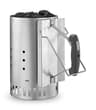
A chimney starter is a steel tube with a grate inside. Charcoal sits on the grate, a cube or some crumpled paper goes underneath, and the tube does the work: hot air rising through a confined column drags fresh air up through the coals, so the fire climbs rather than sitting there. That is why the thing is called a chimney, and it is the reason it beats a pile of fluid-soaked briquettes on a flat grate — a pile has no draft.

Our guide to lighting a charcoal grill walks through the method step by step, including the two mistakes that make a chimney look slow: poking it, and judging it by the bottom coals instead of the top. The fire starts underneath and climbs, so the bottom will glow long before the load is lit.

The other practical advantage is control. A chimney pours a measured column of lit coals exactly where you want them, which is how a two-zone fire gets built. Fluid lights everything at once, everywhere, which is fine for burgers and useless for indirect cooking.

Which to buy for which grill

  • A 22-inch kettle. Full-size chimney, every time. The Weber Rapidfire holds enough to fill a kettle grate in one load, and its second handle with a heat shield is what makes the pour controllable rather than frightening.
  • A tabletop, portable or small kettle. A full-size chimney lights far more charcoal than a small grill can hold, and the surplus just burns out on the patio. The Kingsford Compact is sized to the grill, which is the point.
  • A patio with an outdoor socket, and no appetite for fire-lighting. The Char-Broil electric starter is a heating element you bury in the coals and plug in. It is slower than a chimney and needs an outlet within reach, but there is no fuel, nothing consumable and no technique.
  • Somebody who already owns a chimney. Buy the cubes. Paraffin cubes light with a match, burn long enough to catch lump charcoal, and remove the one remaining annoyance of a chimney — finding dry newspaper that is not glossy.

If the tipping step itself is the worry — and for plenty of people it genuinely is — there is a third design we cover in the full chimney-starter roundup: a trigger-release chimney that drops the coals straight down instead of asking you to tip a glowing cylinder over.

Three things this decision is not about

It is not about which charcoal you use. Both methods light briquettes and lump. Lump catches more easily and burns hotter, briquettes burn more predictably — that is a separate decision, covered in lump charcoal vs briquettes and the charcoal roundup.

It is not about self-lighting briquettes. Those are briquettes with the fluid already in them. They solve the convenience problem and keep the taste problem, and they cost more per pound than plain charcoal plus a cube.

It is not about smoke flavor. Neither method adds smoke. If somebody wants their food to taste of wood rather than just of fire, that comes from wood chips or chunks on the coals, not from how the coals were lit.

The honest verdict

A chimney starter is the cheapest object in charcoal grilling that changes the result, and the one accessory we would give a charcoal griller who owns nothing else. Lighter fluid is not a scandal — used exactly as Kingsford instructs, with the fluid fully burned off and the coals ashed over, it works. But it asks you to wait for a signal you cannot see, it costs money every time, and it puts a bottle of accelerant next to a hot grill. For a once-a-year griller with a bag of briquettes already open, fine. For anybody who grills on purpose, the tube is better in every row of the table above.

Still choosing between chimneys rather than between methods? Weber vs Kingsford chimney starter compares the two most common ones directly, and our Kingsford review covers the cheap one on its own.
Frequently asked questions

Is a chimney starter better than lighter fluid?

For almost everyone, yes. A chimney is a one-off purchase with no running cost, it gives a clear visual signal when the coals are ready, it pours lit coals exactly where you want them for two-zone cooking, and there is nothing flammable to add to a hot fire. Lighter fluid works if you follow Kingsford's instructions exactly, but you rebuy it forever and have to wait for it to burn off before cooking.

Do you need lighter fluid with a chimney starter?

No, and you should not use it. A chimney is lit from underneath with a paraffin cube or crumpled newspaper, and the tube's draft does the rest. Adding fluid inside a chimney is both unnecessary and a bad idea, because the design is built to amplify a flame.

Does lighter fluid make food taste bad?

Only if the food goes on before the fluid has burned off. Kingsford's own instruction is to wait until the fluid has burned off and the coals are mostly covered in gray ash - the problem is that there is no clear moment when that has happened, so people start cooking early. A chimney removes the guesswork: when the top coals gray over, it is ready.

How long does a chimney starter take?

Longer than people hope and less time than it feels. Judge it by the coals at the very top of the chimney, not the bottom - the fire climbs, so the bottom glows first. When the top coals are glowing at the edges and starting to gray over, pour. Poking a slow-starting chimney interrupts the draft and is the main reason one fails to light.

Can you add lighter fluid to hot coals?

No. Kingsford states plainly on its own page that you must never add lighter fluid to hot or flaming coals. It is the most dangerous habit in charcoal grilling, and it is the strongest single argument for not having a bottle of fluid on the patio at all.

What about an electric charcoal starter?

It is a genuine third option if there is an outdoor outlet within reach. You bury the element in the coals, plug it in, and there is no fuel, no fumes and no technique to learn. The trade-offs are that it is slower than a chimney, it is useless without power, and the element has to cool before you can store it.

Are self-lighting briquettes a good shortcut?

They are briquettes with lighter fluid already added, so they inherit the same rule: let them burn off before the food goes on. They cost more per pound than plain charcoal, and plain charcoal plus a paraffin cube is cheaper and cleaner. Convenient for a one-off cook, poor value as a habit.

What size chimney starter should I buy?

Match it to the grill. A full-size chimney like the Weber Rapidfire holds enough to fill a 22-inch kettle grate in one load. On a tabletop or portable grill a full-size chimney lights far more charcoal than the grill can hold, so a compact one is the better buy - the surplus coals just burn out on the patio.

Sources

  • Kingsford - How to Light Charcoal (with Lighter Fluid) — Kingsford's own lighter-fluid method: pile the charcoal into a mound or pyramid so the fire spreads faster, squirt fluid over the top and sides of the pile, light it right away, and never add fluid to hot or flaming coals. Kingsford gives no wait time in minutes - it says to wait until the fluid has burned off and the coals are mostly covered in gray ash. Its guide suggests roughly a 10-second squirt for a chimney's worth of charcoal while the bottle directions call for 1.6 fl oz per pound of charcoal, so the two Kingsford figures do not agree and the bottle is the one to follow. kingsford.com does not serve an automated fetch, so this page was read via live web search of that exact URL on 2026-10-22 (accessed October 22, 2026)
  • Kingsford - How Much Charcoal to Use in a Grill & How to Stack It — Kingsford's own quantity chart, measured in standard chimneys (it states a standard chimney holds about 100 briquets): high heat 450-550F is 1 full chimney / about 4 lb; a two-zone fire is about 1/2 to 1 chimney / 2-4 lb; low-and-slow by the snake method is about 4 lb of unlit briquets lit with 6 to 8 coals. For a 22-inch grill: about 1/2 to 3/4 chimney (2-3 lb) for medium heat, a full chimney (about 4 lb) for high heat, 1/4 to 1/2 chimney (about 2 lb) banked to one side for indirect. For a 14-inch grill: about 1/4 chimney (about 1 lb) for medium, 1/2 chimney (about 2 lb) for high, 1/4 chimney for indirect. Kingsford's FAQ adds a planning figure of about 4 lb per session on a standard kettle. kingsford.com does not serve an automated fetch, so this page was read via live web search of that exact URL on 2026-10-17 (accessed October 17, 2026)
  • Weber - How to Control the Temperature of Your Charcoal Grill — Weber's vent guidance: the top vent fully open for high heat and roughly a quarter open for low heat, with the bottom (bowl) vents left open so the fire does not die. weber.com redirects to amer.weber.com, which 404s to an automated fetch, so this page was read via live web search of that exact URL on 2026-10-17 (accessed October 17, 2026)
  • Weber - 10 Tips for the Weber Way of Grilling — Keep the bottom vent open while grilling so the fire does not die; to slow fuel consumption close the top vent as much as halfway and keep the lid on as much as possible. Read via live web search of that exact URL on 2026-10-17 (accessed October 17, 2026)

Keep reading