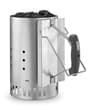
How to choose a chimney starter
Match the capacity to the grill. This is the only decision that really matters. A full-size chimney holds enough charcoal for a 22-inch kettle grate. Give one to somebody with a tabletop grill and every cook wastes half a load of charcoal, burning away on the patio because there is nowhere to put it.
If the grill itself has not been bought yet, size the chimney to the grill rather than the other way round — our best charcoal grills guide lists the grate area of every pick, and a full-size chimney suits anything from a 22-inch kettle upward.
Look at the second handle. Cheap chimneys have one handle. Better ones add a second, angled helper handle with a heat shield, and it transforms the pour from a one-armed lift into a controlled two-handed movement. If you only compare one feature, compare this.
Check the gauge. Chimneys live a brutal life, going from ambient to several hundred degrees and back, repeatedly, outdoors. Thin steel warps and eventually burns through. Heavy-duty versions cost a few dollars more and last years longer.
Decide how the coals come out. Standard chimneys are tipped. Trigger models release the base and drop the coals straight down, which removes the most alarming part of charcoal grilling for anyone nervous or with weak wrists.
The chimney sizes, side by side
| Type | Suits | Trade-off |
|---|
| Full-size / heavy duty | 22-inch kettles, barrel grills, big cooks | Overkill on a small grill; wastes charcoal |
| Compact | Tabletop, portable and small kettle grills | Two loads needed to fill a full-size grate |
| Split / half-load | Households that cook for two and for eight | Bulkier to store, more parts |
| Trigger release | Nervous users, wrist trouble, precise pours | A mechanism that can gum up over time |
| Electric starter | Patios with an outdoor socket | Needs power; slower than a chimney |
How to use one, properly
Fill the upper chamber with charcoal. Put two sheets of crumpled paper or a paraffin cube in the lower chamber. Set the chimney on the charcoal grate of the grill — not on grass, not on a wooden deck — and light the paper through the vent holes.
Leave it alone. Twelve to fifteen minutes later the top coals will be glowing at the edges and graying with ash; that is the signal. Pour them out with gloves on, using both handles, away from your body. Bank them to one side if you want a two-zone fire, which is the setup nearly every technique in our steak guide depends on.
Two things people get wrong: overfilling — a chimney does not need to be packed to the brim — and impatience. Coals poured too early are still black underneath and will not hold temperature through a cook.
What to light it with
Newspaper is free and works. It is also increasingly hard to find in a house, and it can leave paper ash blowing around the yard. Paraffin lighter cubes cost very little, light from a match, burn steadily for several minutes, and are far more reliable in wind — which is why we included a box of them as a pick rather than an afterthought.
What not to use: lighter fluid inside a chimney. It defeats the entire purpose, and a chimney’s draft is exactly the wrong environment for it. Glossy printed paper is also worth avoiding.
The electric option, honestly
An electric starter is a heating element you bury in the coals and plug in. There is no fire to build, no paper, no cubes, and no cylinder to tip — which for some people is the entire argument.
The catch is an outdoor socket. Without one, it is a non-starter, and running an extension lead across a patio to a hot grill is not something we would recommend as a routine. It is also slower than a chimney, and the element needs to cool before it can be put away. Where there is a socket and the recipient dislikes fire-building, it is genuinely the easiest way to light charcoal.
Why this is such a good gift
Because the recipient almost certainly knows they should own one and has never got around to it. It is a fifteen-to-twenty-five-dollar object that improves every single cook, which is a better return than anything else at that price.
It also completes bigger gifts. Anyone receiving a charcoal kettle needs one on day one; giving the grill without it is like giving a car with an empty tank. Add a bristle-free brush and a bag from our charcoal guide and you have a complete kit.
The one thing to check first: fuel type. A chimney starter is useless to somebody with a gas or pellet grill, and there is no polite way around that. If you are not sure what they cook on, our beginner gift guide has picks that work regardless.
The two chimneys people actually choose between get their own page: Weber vs Kingsford chimney starter sets out exactly what the extra money buys, and our Kingsford review covers the cheaper one on its own.