What it does that lighter fluid does not
Two things. The first is taste. Lighter fluid is a petroleum product and if the coals go on the grill before it has fully burned off — which is most of the time, because nobody waits — some of it ends up in the food. People who switch to a chimney usually describe the difference as their food tasting cleaner, and they are not imagining it.
The second is evenness. A chimney works as a flue: heat rises through the stack of coals and lights them from the bottom up, so the whole load reaches temperature at roughly the same time. Coals doused in fluid light unevenly, which leaves cold patches on the grate and is the real reason a first burger comes off half raw.
What the compact version is, and what happened to the big one
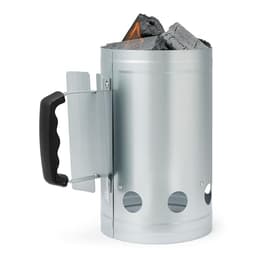
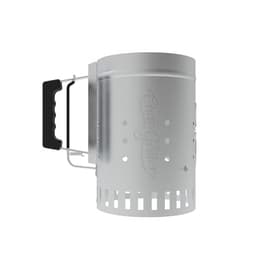
Kingsford’s listing for this one is short: a zinc steel starter with a heat shield and a stay-cool handle, no assembly, sized to fit compact grills and travel. That is the whole specification, and for this object it is enough — a chimney is a cylinder with a grate in it, and the only real variables are how much it holds, what the handle is like and how thick the metal is.
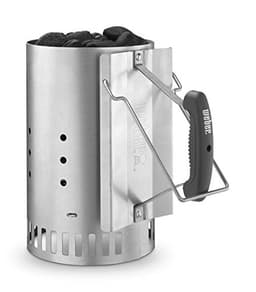
Worth saying plainly, because people arrive here looking for it: the Kingsford Heavy Duty Deluxe, the large-capacity version this review used to cover, is no longer sold on Amazon as a single unit — only as a six-pack. The Compact is the Kingsford chimney you can still buy, so it is the one reviewed here. If the recipient has a full-size grill, skip to the chimney starter roundup, which lists the full-size options that are still in stock.
Capacity is the decision, and it cuts both ways. A compact chimney lights roughly the amount of charcoal a tabletop or small kettle grill can actually use. On a 22-inch kettle that means either lighting twice or accepting a thin bed of coals that runs out of heat early. Match it to their grill and it is the better gift; mismatch it and it is the annoying one.
Gauge matters over time too, and it is where the money saved shows up. Thin chimneys warp and eventually burn through, because the metal spends its life going from ambient to several hundred degrees and back, often into damp storage. This is a light, cheap chimney rather than a heavy-duty one — expect it to earn its money several times over and still need replacing before a premium one would.
Using one, in three lines
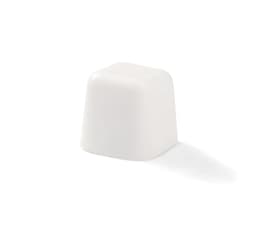
Fill the top section with charcoal. Put two sheets of crumpled newspaper or a paraffin lighter cube in the bottom chamber, set the chimney on the grill’s charcoal grate, and light the paper. When the coals at the top are ashed over and glowing at the edges — usually twelve to fifteen minutes — pour them out and arrange them.
The pour is the only part that needs care, and it is where most of the fear lives. Wear heat gloves and pour away from your body. This one has a single stay-cool handle rather than a second helper grip, so a smaller load is genuinely easier to control. If that still sounds alarming, there are chimneys with a trigger release that drop the coals straight down instead.
The honest downsides
It is useless to a gas griller. This is the single most important thing to check before buying. A chimney starter given to someone with a propane grill is a confusing object, not a gift.
It gets extremely hot and stays hot. After the pour it needs somewhere safe to sit — concrete or the grill grate, never grass or a wooden deck. This is worth mentioning to a first-time charcoal user.
It needs something to light. Newspaper works and is free, but fewer households have newspaper lying around than they did ten years ago. Paraffin lighter cubes are cheap and much more reliable, and they make an obvious pairing.
It is not a gift on its own for a big occasion. At this price it is a stocking filler, an add-on, or one item in a basket. As the sole present for a birthday it reads as an afterthought, however useful it is.
Who to buy it for
Any charcoal griller who is still squeezing fluid onto briquettes, as long as the grill is a small one. A tabletop or portable charcoal grill, a balcony setup, a camping grill, a small kettle — this is sized to all of those. Anyone who has said they find charcoal a hassle also qualifies, because most of the hassle they are describing is the lighting.
Give a full-size chimney instead to anyone with a 22-inch kettleor larger — a kettle without a chimney is only half a gift, but it wants the load that fills its grate.
It is also the right choice when your budget is small and you want the money to actually change something. Pound for pound this is the best-spent money on the site: nothing else at stocking-filler prices changes the food as much.
What to pair it with
Lighter cubes, a bag of good charcoal, and gloves. That is a complete, genuinely useful gift for well under fifty dollars, and it is one of the highest-value combinations on the under-$25 list once you spread it across a couple of items.