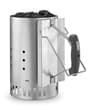
The head-to-head
| | Premium chimney | Value chimney |
|---|
| Does the core job | Yes | Yes |
| Time to ashed-over coals | ~15–20 min | ~15–20 min |
| Load size | Full-size — a bed across a 22-inch grate | Compact — sized to tabletop and small grills |
| Handle | Insulated grip plus a second heat shield | Stay-cool grip and heat shield, single handle |
| Metal | Heavier gauge | Lighter-gauge zinc steel |
| Typical lifespan | Many seasons | A few seasons |
| Presents as a gift | Reasonably | Needs pairing |
| Price bracket | Stocking-filler plus | Add-on money |
What the extra money actually buys
Two things, and neither is speed. Both chimneys take roughly the same time to produce ashed-over coals, because that is governed by airflow and the charcoal itself rather than by brand.
Metal thickness. A chimney lives through repeated cycles of extreme heat followed by cold, often wet, storage. Thin steel warps and eventually burns through at the base; heavier gauge takes far longer to get there. This is where the price difference goes, and it is why a premium chimney is often still in use after a cheap one has been replaced twice.
The handle. This sounds cosmetic and is not. The most dangerous moment with any chimney is tipping a cylinder of glowing coals into the grill, one-handed, at arm height. A second grip or heat shield gives control over that pour, and control is the whole safety story. If you are buying for somebody nervous about fire, it is worth the difference on its own.
Where the cheaper one is the right answer
When it is going into a bigger gift. A chimney is a supporting object — nobody unwraps a steel cylinder with delight — and inside a basket alongside a rub set and a bag of charcoal, the brand on it is not what makes the gift work.
It is also right for someone who is not sure they will stick with charcoal. If they are trying it for a season, a cheaper chimney is the sensible experiment. The upgrade path is obvious and they can take it themselves.
And it is right when the grill is small. The Kingsford here is the Compact, which lights about as much charcoal as a tabletop or small kettle grill can use — on that grill it is not a compromise, it is the correct size.
Capacity is the real difference here
This is where the two part company, and it matters more than the price gap. The Weber is a full-size chimney: a full load covers roughly half of a twenty-two inch kettle grate in a single-layer bed, which is exactly what you want for two-zone cooking, with a hot side and a cool side. The Kingsford in this comparison is the Compact — Kingsford’s large-capacity Heavy Duty Deluxe is no longer sold as a single unit, so the Compact is the Kingsford chimney you can actually buy.
A smaller chimney is not simply a cheaper version of the same thing. On a full-size grill it means either lighting twice or accepting a thinner bed of coals that runs out of heat sooner. So the honest rule is: full-size for a kettle or a large charcoal grill, compact for a tabletop or a portable. If the recipient has a 22-inch kettle and the Weber is out of budget, take a full-size chimney from the chimney roundup rather than a compact one. Our two-zone guide explains why the bed size is the thing that matters.
Both beat lighter fluid, and that's the real point
The gap between either of these and a bottle of lighter fluid is far larger than the gap between the two of them. Fluid leaves a distinct taste if the coals are used before it has fully burned off, which is exactly what an impatient cook does. A chimney removes the question entirely: when the top coals are ashed over gray, they are ready, and there is nothing left to burn off.
It also removes the least safe part of charcoal grilling, which is adding fluid to coals that are already lit. Whichever of these you choose, you are giving somebody better-tasting food and one fewer way to hurt themselves. The full method is in our charcoal lighting guide.
The verdict
Buy the premium one if it is the actual gift, if they grill on a full-size kettle, if they cook on charcoal regularly, or if they are at all nervous about handling fire — the better handle is worth it for that alone. Buy the Kingsford Compact if the grill is a small one, if the chimney is going into a basket with other things, or if charcoal is still an experiment for them.
What you should not do is skip the chimney because it seems like a boring gift and buy something more exciting instead. It is the cheapest object on this entire site that changes how somebody’s food tastes. There is a full write-up of the value pick in our Kingsford chimney starter review.