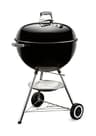
The four charcoal shapes, and who each one is for
Every charcoal grill on the market is a variation on one of four layouts. Working out which layout suits the person you are buying for narrows eight choices down to two or three almost immediately.
| Shape | What it is good at | What it is bad at | Buy it for |
|---|
| Kettle | Two-zone cooking, searing, roasting a whole chicken with the lid on | Cooking for a crowd — 363 sq in is one layer of food | Almost everybody, and every first-time charcoal cook |
| Barrel | Lots of grate area for the money, feeding a party | Holding a low temperature; there is little depth for indirect heat | The host who cooks twenty burgers at once, twice a summer |
| Kamado | Holding one temperature for hours, and hitting very high heat | Being moved, and being cheap | The griller who already talks about brisket and pizza |
| Offset | Real barbecue — smoke passing over food from a separate firebox | Quick weeknight dinners; it wants hours of fire management | Somebody who has explicitly said they want to smoke |
If you take one thing from that table, take this: a kettle is the default answer for a reason. It is the only shape on the list that does a bit of everything competently, and it is the shape a beginner is least likely to outgrow or resent. The other three are all better than a kettle at one specific job and worse at the rest.
Why the vents matter more than the size
A charcoal fire does not have a dial. What it has is a supply of oxygen, and the vents are how you control it. Open the bottom intake wide and the coals roar; close it to a crack and they idle. The top vent controls how fast that hot air leaves, which is what actually sets the temperature inside the dome.
This is why a good kettle can cook a steak at searing heat and, an hour later, hold 250°F under a pork shoulder on the same load of charcoal — and why a cheap grill with a fixed lid opening cannot. When you are comparing two grills, look for an adjustable damper at the bottom and an adjustable one at the top. If the listing does not mention both, you are looking at a grill that can only run hot. Our guide to smoking on a charcoal grill gives Weber’s own vent settings for a low cook.
The insulated cookers take this further. A kamado’s thick walls mean the fire barely has to work to maintain a temperature, which is why Kamado Joe rates the Classic Joe from 225 to 750°F and Char-Griller rates the AKORN from 200 to 700°F on a single load. Thin steel cannot do that, because it loses through the walls whatever the fire produces. If they are weighing exactly that choice, our kamado vs kettle comparison sets the two side by side, and best grills for searing steak ranks both against pellet and gas on heat alone.
How much grate do they actually need?
Grate area is the spec people over-buy on, usually because a bigger number feels like a better gift. In practice, more grate than you need is worse than slightly less, because it takes more charcoal to bring up to temperature and gives you a large cold zone you never use.
| Who they cook for | Grate area to look for | On this list |
|---|
| One or two people, a balcony or a campsite | Around 240 sq in | Weber Jumbo Joe |
| A family of four to six, most weekends | Around 360 sq in | Any of the three 22-inch Weber kettles |
| Regular parties and cook-for-a-crowd duty | 450 sq in and up | Royal Gourmet CD1824M, Char-Griller AKORN |
| Whole briskets, pork butts, all-day cooks | Grate area matters less than fuel capacity and insulation | Kamado Joe Classic Joe II, Oklahoma Joe’s Laredo 1100 |
Note the last row. For long cooks the useful question is not how much food fits but how long the grill will hold a temperature without you touching it, which comes down to insulation and how much charcoal the firebox takes. Char-Griller lists a 3.1 lb maximum charcoal load on the AKORN and Royal Gourmet lists 4.5 lb on the CD1824M — both are honest numbers, and both tell you those grills are happier with a long afternoon than a fourteen-hour overnight.
What we would skip
Any charcoal grill without a lid. An open brazier can only do one thing: burn the outside of food over direct heat. A lid is what turns a grill into an oven, and it is the difference between grilled chicken and burnt chicken.
The very cheapest big-box barrel grills. Below the Royal Gourmet’s price band the steel gets thin enough that the body distorts after a season and the legs arrive bent. There is a real floor on charcoal grills, and it is higher than the thirty-dollar shelf suggests.
Grills from brands with no parts. Every charcoal grill eventually needs a grate, a damper or a set of legs. Weber publishes a 10-year warranty on the kettle bowl and lid and sells replacement parts for models two decades old; a house-brand grill from a seasonal aisle has neither. This is the single biggest difference between a grill that gets handed down and a grill that goes to the tip.
Lighter fluid, as a gift add-on. It is the most common charcoal accessory and the one most likely to make their food taste of chemicals. A chimney starter does the same job in twenty minutes with a sheet of newspaper — see our chimney starter guide for the cheapest worthwhile upgrade you can put in the box alongside the grill.
What each budget actually buys
| Bracket | What you get |
|---|
| Under $100 | A genuine portable from a real brand — 18 inches of grate, a lid and a carry handle |
| $100–$200 | A full-size grill: either a wide budget barrel with a crank-adjustable coal bed, or the plain 22-inch Weber kettle |
| $200–$300 | The kettle with the convenience features — thermometer, enclosed ash catcher, hinged grate, char-rails |
| $300–$450 | A specialist cooker: an insulated steel kamado, or a true offset smoker |
| $800 and up | Ceramic. A lifetime-warranty body, a 750°F ceiling and a multi-level rack system |
The brackets are deliberately qualitative, because charcoal grill prices move constantly and the live figure on each pick above is the only one worth acting on. What does not move is the shape of the ladder: the jump from $150 to $250 buys convenience on the same grill, and the jump from $300 to $1,200 buys a different cooking method entirely.
What to put in the box alongside it
A charcoal grill on its own is an incomplete gift, and the three things that complete it are cheap. A chimney starter, because lighting coals properly is the difference between twenty minutes and an hour. A pair of long heat gloves, because charcoal grills need the coals moved by hand far more than gas grills do — see the gloves we would pick. And an instant-read thermometer, because a lid gauge measures the air near the dome rather than the middle of the meat.
If you want the full list of add-ons at a sensible price, our grilling gifts under $50 page is built around exactly that problem, and the best grills for beginners covers the same decision from the other direction, with gas and flat-top options included for the case where charcoal turns out to be the wrong answer. If it is specifically a Weber kettle under consideration, kettle vs Master-Touch sets out what each step up in price actually adds.
Two decisions sit either side of this page. If you have not settled on charcoal at all, charcoal vs pellet grill sets the fire against the thermostat on published figures. And once the grill arrives, the two things that decide whether it cooks well are fuel quantity and airflow — how much charcoal to use has Kingsford’s own chart, and charcoal grill vents explained covers which vent is the dial.