How Much Charcoal to Use (By Grill Size)
Kingsford publishes the answer in chimneys, not handfuls. Here are its quantities for a 22-inch kettle, a small grill, a two-zone fire and a long smoke.
Quick answer
For most grilling on a 22-inch charcoal grill, Kingsford says use about half to three-quarters of a chimney(2–3 lb) of briquettes for medium heat, a full chimney (about 4 lb) for high heat, and a quarter to half a chimney (about 2 lb) banked to one side for low, indirect cooking. A standard chimney holds about 100 briquettes. On a 14-inch grill, halve it.
“Enough charcoal” is the vaguest instruction in grilling, and it is the reason two cooks on the same kettle get completely different results. The good news is that the biggest charcoal maker publishes real numbers, and it measures them in chimney-fulls, which is the only unit that is actually easy to use: fill the chimney to the line you want, light it, pour it in.
Everything below is Kingsford’s own chart, which is built around a standard charcoal chimney it states holds about 100 briquettes. Nothing here is our estimate.
Kingsford’s quantities, by grill size
| Grill and heat | Chimney | Weight | Roughly, in briquettes |
|---|---|---|---|
| 22-inch grill, high heat | 1 full | About 4 lb | About 100 |
| 22-inch grill, medium heat | ½ to ¾ | 2–3 lb | 50–75 |
| 22-inch grill, indirect / low | ¼ to ½, banked to one side | About 2 lb | 25–50 |
| 14-inch grill, high heat | ½ | About 2 lb | About 50 |
| 14-inch grill, medium heat | ¼ | About 1 lb | About 25 |
| 14-inch grill, indirect | ¼ | About 1 lb | About 25 |
| Two-zone fire | ½ to 1 | 2–4 lb | 50–100 |
| Low and slow, snake method (225–275°F) | — | About 4 lb unlit | About 100 unlit, lit with 6–8 coals |
Kingsford also publishes a planning figure worth remembering when you are buying rather than cooking: about four pounds of charcoal per grilling session on a standard kettle. A 16 lb bag is therefore roughly four cookouts, which is the number to do your shopping with.
How to read the chart without a scale
Nobody weighs charcoal. Use the chimney as the measure and mark it mentally in quarters — a full chimney, three-quarters, half. Fill to the line, light it with a cube or a sheet of newspaper underneath, and wait until the coals at the top are ashed over gray. That is one load, every time, which is what makes a cook repeatable.
The one case where you count individual briquettes is the snake method, because the arrangement matters more than the quantity: Kingsford’s version is about 100 unlit briquettes laid in two rows around the edge of the grill, started with just 6 to 8 lit coals at one end. The fire then creeps along the snake for hours at 225–250°F.
Three things that change the number
Cold and wind. Both pull heat out of the grill, so a winter cook wants more fuel than the chart says and a longer preheat. Our cold-weather guide has the detail.
Lump versus briquettes. Lump charcoal is irregular, so a chimney-full weighs differently and burns hotter and faster. Kingsford’s chart is written for briquettes; lump vs briquettes explains what changes when you switch.
How long the cook is. Charcoal burns out. For anything over about an hour, plan to add unlit coals round the edge of the lit ones, or light a second small chimney while the first is cooking.
The mistake that wastes most charcoal
Lighting a full chimney for a weeknight dinner. Two chicken breasts do not need 100 briquettes, and the extra fuel does not vanish — it burns out on your patio while you eat. Match the load to the food, close both vents when you are done to smother what is left, and reuse it next time. On a small grill, a full-size chimney is the wrong tool altogether: it lights more coals than the grill can hold.
What to look for in the gear
Measuring charcoal properly needs three things, and the criteria are easy to state. A chimney sized to the grill, so a full load is the right load rather than an overflowing one. A briquette that behaves the same way twice, which is the whole argument for uniform briquettes over lump while you are learning. And a starter that lights the bottom of the chimney without lighter fluid, because fluid flavors the food and adds nothing a paraffin cube does not do better.
What to measure and light it with
Picks from our shortlists, matched to the criteria above: the right-sized chimney, a predictable briquette, and a clean way to light it. Prices are fetched live.
How this is funded: we earn a commission if you buy through our links, at no extra cost to you. It never changes which gift we recommend, and we’ll tell you when we’d skip one. Full disclosure.
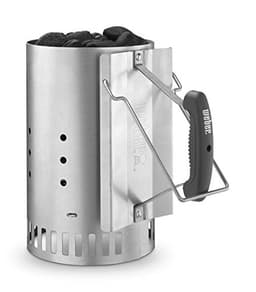
Weber Rapidfire Chimney Starter (Standard)
Full-size: capacity matched to a 22-inch kettle, so one full load is Kingsford's high-heat quantity. The heat-shielded second handle is what makes the pour controllable.
$24.99 · View on AmazonPrice as of October 24, 2026. #ad How we’re funded
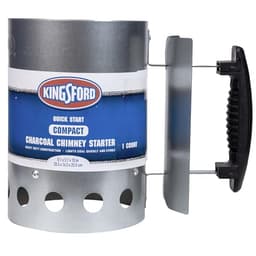
Kingsford Compact Charcoal Chimney Starter
For a tabletop, portable or 14-inch grill, where a full-size chimney lights far more charcoal than the grill can hold.
$15.99 · View on AmazonPrice as of October 24, 2026. #ad How we’re funded
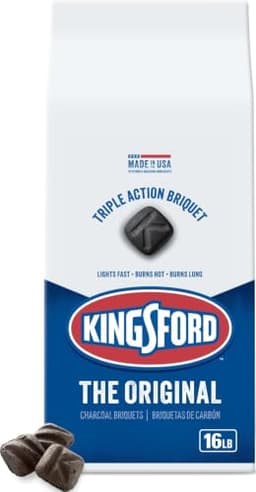
Kingsford Original Charcoal Briquettes, 16 lb
The bag the chart is written for. Kingsford publishes a ready-to-cook time of about 15 minutes, and uniform briquettes are what make a measured load repeatable.
$10.92 · View on AmazonPrice as of October 24, 2026. #ad How we’re funded
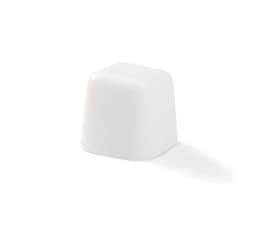
Weber Charcoal Lighter Cubes (96 Count)
Paraffin cubes light the bottom of a chimney with a match and burn long enough to catch the coals - no lighter fluid, no fuel taste. Ninety-six is most of a season.
$23.96 · View on AmazonPrice as of October 24, 2026. #ad How we’re funded
Once the load is right, the airflow is the other half of the job: charcoal grill vents explained covers which vent to move and which way. For the lighting routine itself, see how to light a charcoal grill.
Frequently asked questions
How much charcoal do I need for a 22-inch grill?
Kingsford's chart says about half to three-quarters of a chimney (2-3 lb) for medium heat, a full chimney (about 4 lb) for high heat, and a quarter to half a chimney (about 2 lb) banked to one side for indirect cooking. A standard chimney holds about 100 briquettes.
How many briquettes is a full chimney?
About 100, per Kingsford, which is also roughly four pounds. That is the measure its whole quantity chart is built on, so half a chimney is about 50 briquettes or two pounds and a quarter is about 25.
How much charcoal for burgers?
Burgers want high, direct heat, so on a 22-inch grill that is a full chimney - about 4 lb or 100 briquettes - spread across most of the grate. On a small 14-inch grill, half a chimney (about 2 lb) does the same job.
How much charcoal for a long smoke?
Kingsford's snake method uses about four pounds of unlit briquettes - roughly 100 - laid in two rows around the edge of the grill and lit with just 6 to 8 coals at one end. That creeps along at 225-250F for hours rather than burning all at once.
Can you add more charcoal while cooking?
Yes, and for any cook over about an hour you will need to. Add unlit briquettes around the edge of the lit ones so they catch gradually, or light a small second chimney and pour it in. Adding a big pile of cold coals all at once drops the temperature hard.
How long does a bag of charcoal last?
Kingsford's own planning figure is about four pounds per grilling session on a standard kettle, so a 16 lb bag is roughly four cookouts of high-heat grilling. Low-and-slow cooks at a quarter-open vent stretch much further, and smothering leftover coals by closing the vents saves what did not burn.
Sources
- Kingsford - How Much Charcoal to Use in a Grill & How to Stack It — Kingsford's own quantity chart, measured in standard chimneys (it states a standard chimney holds about 100 briquets): high heat 450-550F is 1 full chimney / about 4 lb; a two-zone fire is about 1/2 to 1 chimney / 2-4 lb; low-and-slow by the snake method is about 4 lb of unlit briquets lit with 6 to 8 coals. For a 22-inch grill: about 1/2 to 3/4 chimney (2-3 lb) for medium heat, a full chimney (about 4 lb) for high heat, 1/4 to 1/2 chimney (about 2 lb) banked to one side for indirect. For a 14-inch grill: about 1/4 chimney (about 1 lb) for medium, 1/2 chimney (about 2 lb) for high, 1/4 chimney for indirect. Kingsford's FAQ adds a planning figure of about 4 lb per session on a standard kettle. kingsford.com does not serve an automated fetch, so this page was read via live web search of that exact URL on 2026-10-17 (accessed October 17, 2026)
- Kingsford — How to Arrange Charcoal in a Grill — The snake method for 225-250°F: about 100 unlit briquets in two rows around the grill, started with 6 to 8 lit coals (accessed September 18, 2026)
Keep reading
Charcoal Grill Vents Explained
Which vent is the dial, which way to move it, and the settings for hot, medium and low.
Read the guideHow to Light a Charcoal Grill
A chimney, a cube and twenty minutes. No lighter fluid.
Read the guideBest Charcoal for Grilling
Six bags compared on published burn times, heat and ash.
See the charcoalLump Charcoal vs Briquettes
What changes when you swap uniform briquettes for irregular lump.
Read the comparison