What the difference actually is
Lump charcoal is wood that has been charred and then bagged as it comes — irregular chunks, from fist-sized down to dust. Briquettes are charcoal that has been ground and pressed into uniform pillows, usually with a binder. That one manufacturing difference drives everything else: uniform shapes burn predictably, irregular chunks burn unpredictably but can be packed denser and run hotter.
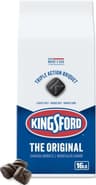
The binder is where the old “briquettes have chemicals in them” argument comes from, and it is worth being precise. Kingsford states that Original is made with 100% natural ingredients and no chemical additives. B&B states that its Competition briquets hold charred oak and hickory together with a vegetable starch binder and contain no chemical additives or fillers. What briquettes do produce is more ash than lump — Kingsford describes Original as burning with “a moderate amount of ash”.
What each maker publishes
| Bag | Type | Light and burn figures the maker publishes | Best use |
|---|
| Kingsford Original, 16 lb | Briquette | Ready to cook on in about 15 minutes; “a moderate amount of ash”; no burn-time figure published | Everyday burgers, chicken, two-zone fires |
| B&B Competition Oak & Hickory, 17.6 lb | Briquette | 17.6 lb bag rated at approximately six uses; no burn time or BTU published | Ribs, pork shoulder, anything low and slow |
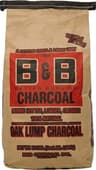
| B&B Oak Lump, 10 lb | Lump | Described as “Low Smoke Profile – High BTU”; B&B publishes no BTU figure, burn time or country of origin | A kettle that needs real heat without a big bag |
| Jealous Devil Chunx XL, 35 lb | Lump | 4+ hours in open air, 20+ hours in a smoker; peak heat given as “exceeds 1,100°F” in one place on its own site and “Exceeds 1,170°F” in another | Steak, searing, long kamado cooks |
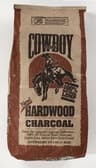
| Cowboy Hardwood Lump, 8.8 lb | Lump | Ready to cook in about 15 minutes, holds heat up to an hour; heat treated to a minimum interior 71°C for 75 minutes under USDA Protocol T-314-c | A single cook, or trying lump for the first time |
Note how little of that table is actually comparable. Two makers publish a burn time, three do not; one advertises “High BTU” without printing a BTU; one contradicts itself on peak temperature by 70 degrees. That is the real state of charcoal specs, and it is why the cells above say not published instead of carrying a number borrowed from a retailer.
Heat: lump wins, with an asterisk
Lump’s advantage is peak temperature. Dense hardwood chunks packed into a kettle will take the grate hotter than the same volume of briquettes, which is why steakhouse-style searing and kamado cooking are lump territory. The asterisk is control: because the pieces are different sizes, a lump fire has hot spots and the small pieces burn out first. For a cook who wants an even grate at a predictable 400°F, that is a bug rather than a feature.
Burn time and consistency: briquettes win
Uniform shape means uniform airflow, and uniform airflow means a fire you can plan around. This matters most on long cooks, where the technique everyone uses — the snake, a ring of unlit coals lit at one end — depends on the fuel being the same size all the way round. Kingsford’s own instructions for the snake method call for roughly 100 unlit briquets arranged in two rows and started with six to eight lit coals to hold 225–250°F. There is no equivalent recipe for lump, because lump cannot be arranged that precisely.
Ash and cleanup: lump wins
Lump leaves noticeably less ash, which matters more than it sounds like it should. Ash smothers airflow at the bottom of a kettle, so a long briquette cook can choke itself unless the ash gets cleared. If the person you are shopping for complains about cleaning the grill more than about cooking on it, a bag of lump and a bristle-free brush is a genuinely useful pairing.
Flavor: what we will and will not say
Every maker on this page claims a cleaner or more natural burn, and several name the wood species — B&B uses oak and hickory, Jealous Devil uses South American quebracho blanco. Species demonstrably affects smoke, which is why wood chunks and chips are sold by species at all. What we will not do is tell you one bag tastes better than another, because we have not cooked the same cut over both, and nobody should trust a site that says otherwise without showing the work.
So which bag, for which cook?
- Burgers, chicken, weeknight grilling: briquettes. Kingsford Original.
- Ribs, shoulder, brisket: briquettes, in a snake. The B&B Competition bag if they are fussy about binders.
- Steak, smash burgers, kamado: lump. Jealous Devil if the bag size is no problem, B&B Oak Lump if it is.
- Just trying lump: the 8.8 lb Cowboy bag. One cook, no commitment.
Whichever bag you land on, the fire still has to be lit properly. A chimney starter does it in about fifteen minutes with no fluid and no taste, and how to light a charcoal grill walks through the whole routine.