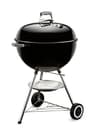
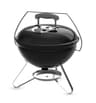
What every pick publishes, side by side
Every number below is Weber’s. Where a cell says “not published”, that is Weber declining to state a figure for that model rather than us hedging. The warranty column is the headline cover Weber lists for the main body — the cookbox on a gas grill, the bowl and lid on a kettle — not the shortest term in the document.
| Model | Fuel | Published cooking area | Heat output | Headline warranty |
|---|
| Original Kettle 22 in | Charcoal | 363 sq in | Charcoal — set by the fuel load | 10 years, bowl and lid |
| Smokey Joe 14 in | Charcoal | Not published on this listing | Charcoal — set by the fuel load | Not published on this listing |
| Original Kettle Premium 22 in | Charcoal | 363 sq in, same bowl as above | Charcoal — set by the fuel load | 10 years, bowl and lid |
| Master-Touch 22 in | Charcoal | 443 sq in total, incl. an 80 sq in warming rack | Charcoal — set by the fuel load | 10 years, bowl and lid |
| Spirit E-325 | Propane | 360 sq in primary, 450 sq in total | 31,000 BTU across 3 burners | 10 years, cookbox / lid / burners |
| Spirit E-210 | Propane | 360 sq in primary, 450 sq in total | 26,600 BTU across 2 burners | 10 years, cookbox |
| Genesis E-315 | Propane | 513 sq in primary, 640.5 sq in total | 39,000 BTU across 3 PureBlu burners | 12 years cookbox, 10 on burners and grates |
| Traveler | Propane (disposable cylinder) | 320 sq in | 13,000 BTU, single burner | Not published on this listing |
Read the cooking-area column and the two most expensive mistakes in the Weber lineup jump out. The Original Kettle and the Premium kettle have the same 363 square inches, and the Spirit E-210 and E-325 have the same 360. In both pairs you are paying for fittings and burners, not for room.
Charcoal: the three 22-inch kettles, honestly
This is the fork most Weber buyers are actually standing at, and the price gap across the three kettles is large enough to matter while the food they cook is identical.
- Original Kettle 22-inch. 363 square inches, One-Touch cleaning, a lid hook, ten years on the bowl and lid. Weber does not list a built-in lid thermometer on this model, the grate is plated steel and is not listed as hinged, and the ash catcher is not the enclosed high-capacity one Weber specifies on the Premium. A clip-on thermometer costs a tiny fraction of the step up.
- Original Kettle Premium 22-inch. Same bowl, plus the built-in lid thermometer and the enclosed ash catcher. If you want the kettle to be a complete object out of the box rather than a project, this is it.
- Master-Touch 22-inch. 443 square inches once you count the 80-square-inch warming rack, a cooking grate that flips up on two sides so you can add fuel without lifting food, two char-rails that hold the coals to one side, a Tuck-Away lid holder and the lid thermometer. These are the four things kettle owners improvise around for years. They are also features a casual griller may genuinely never use.
The honest rule: if they have never cooked on charcoal, buy the Original Kettle and spend the difference on a chimney starter and a thermometer, which will change their results far more than a lid holder. If they already own a kettle and talk about ribs or pork butt, the Master-Touch’s char-rails and flip-up grate are the upgrade that pays back. Our kettle versus Master-Touch comparison works through all three side by side.
Gas: burner count is not footprint
The single most common Weber gas mistake is buying the Spirit E-210 to save space. It does not save space. Weber gives the E-210 the same 360 square inches primary and 450 total as the E-325, in the same cabinet — the E-325 is listed at 48 inches wide with the lid down and the E-210 shares that footprint. What you give up for the lower price is the third burner and 4,400 BTU, and with it some of the ease of setting up a genuine hot zone and cool zone.
The Genesis E-315 is a different proposition, not a bigger Spirit: 513 square inches primary and 640.5 total, 39,000 BTU across three PureBlu burners, and a 12-year cookbox warranty against the Spirit’s 10. It is also 162 pounds and 57.7 inches wide, which makes it a permanent fixture. Our Spirit versus Genesis comparison lays out exactly what the step up buys, and best gas grills sets both against the non-Weber options at the same money.
Why Weber at all: the parts argument
Weber grills are not cheap, and the defensible case for paying the premium is not that the food tastes different. It is that the grill stays repairable. Burners, grates, ignition modules and bowls for the current Spirit, Genesis and kettle lines are stocked widely, which turns a failed burner ten years out into a twenty-minute job rather than a new grill. That is also why Weber’s own warranties read in decades — ten years on the kettle bowl and lid, ten on the Spirit cookbox, twelve on the Genesis cookbox — where most of this category publishes one or two.
Two honest caveats. Weber publishes no cooking area or warranty on the Smokey Joe and Traveler listings we read, so those cells stay blank above rather than borrowing a figure. And Weber is mid-migration between weber.com and amer.weber.com, which is why some of our figures are recorded as read via a live search of the exact spec URL rather than a direct fetch.
Portable: the Smokey Joe, the Go-Anywhere and the Traveler
Three Webers travel, and they are not interchangeable. The Smokey Joe is the kettle shrunk to 14 inches with a carry handle — the cheapest way to give somebody a genuine Weber, and small enough for a balcony, though 14 inches cooks for two or three rather than a party. The Go-Anywhere is rectangular, which suits sausages, corn and skewers far better than a small round bowl, and its legs fold over the lid so it carries like a case. The Traveler is the only portable here that is a real gas grill: 320 square inches, 13,000 BTU, porcelain-enameled cast-iron grates, folds flat one-handed, 49 pounds on wheels. It runs on a disposable cylinder sold separately and has one burner, so heat zones are limited.
Full options at that end of the range, Weber and otherwise, are in best portable grills, and Traveler versus Coleman RoadTrip is the comparison people actually want before buying a tailgate grill.
Buying a Weber as a gift
A grill is the largest object most people will ever be given, so four rules before you spend.
- Confirm the fuel before the model. A charcoal grill given to somebody who wanted gas becomes a planter. If you do not know, read gas versus charcoal and then just ask them.
- Measure the space, not the grill. The Spirit cabinet is 48 inches wide and the Genesis 57.7, and both need clearance from siding and railings. The NFPA’s own grilling guidance is to keep a grill well away from the house, deck railings and anything overhanging.
- Budget for the two things not in the box. Propane tanks are sold separately on every gas grill here, and a charcoal grill needs charcoal and a way to light it. A grill that cannot be used on the day it is opened is a worse gift than a cheaper one that can.
- Add a cover. Weber sells fitted covers and so do several third parties; best grill covers sorts them by published fit.
Once the cooker is chosen, the parts are their own problem. Best Weber grill accessories is split by which Weber you own rather than ranked, because Weber publishes explicit fits and does-not-fit lists and they are narrower than people assume — the 7652 rotisserie fits no Spirit at all, and the 2290 kettle ring fits neither an 18-inch nor a 26-inch kettle. If the Weber in question is a Q, see also best portable gas grills.