Measure first: the three numbers you need
Width, depth and height, taken with the lid closed and the side tables out if they stay out. Width is the one that matters most, because it is the dimension a cover cannot stretch over. Then buy a cover whose stated fit is at or slightly above those numbers: Unicook, for example, publishes a cover measuring 60 in wide and states it fits grills up to 58 in wide, which is the two-inch allowance you want.
If you are buying as a gift and cannot get a tape measure near the grill without ruining the surprise, there is a reliable shortcut: find the model name on the lid or the control panel and look up that grill’s own published dimensions. Nearly every grill maker lists them.
| Cover | Published fit | Fabric, as published | Warranty |
|---|
| Unicook 60 in | 60 x 23 x 42 in; grills to 58 in wide | Fade-resistant fabric, waterproof vinyl underlining; no denier given | None published |
| Weber 7150 | 22 in Weber charcoal grills without a side table | Polyester with UV inhibitors; breathable, water resistant | None published on the cover page |
| iCOVER kettle | 26.5 x 26.5 x 36 in | Oxford polyester, water-resistant PVC coating, UV-resistant outer | None published |
| Ravenna 70 in | 70 x 30 x 48 in | Gardelle One woven polyester, UV-stabilized coating, laminated backing | Two-year limited |
| Blackstone 5483 | 28 in griddles with a hood | 600D polyester, water-resistant PVC coating | None published |
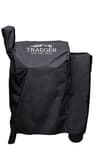
| Traeger BAC503 | Pro 575 / Pro 22 and related models | Heavy-duty all-weather, water resistant; no denier given | None published |
| Ravenna kamado 60 in | Ceramic grills with offset table, 60 x 30 x 50 in | Gardelle One woven polyester, UV-stabilized coating, laminated backing | Two-year limited |
Nobody sells a waterproof grill cover. Read the wording
Weber, Traeger and Classic Accessories all say water resistant. Blackstone and iCOVER describe a water-resistant coating. Unicook is the only one here that uses the word waterproof, and it applies it to the vinyl underlining rather than the whole cover.
That is not evasion so much as physics: a genuinely sealed cover traps evaporated moisture against the metal, which is worse than letting a little rain through. It is why the better covers have vents and why Weber specifies “breathable” as a feature alongside water resistance. A cover’s real job is to keep the bulk of the weather off and let the rest dry out.
Fabric: the one number most brands will not give you
Denier — the weight of the fiber — is the standard way to compare cover fabrics, and only Blackstone publishes it here, at 600D. That is genuinely mid-weight: real material, not the heaviest made. Unicook, Traeger and Weber describe their fabric in words only, and iCOVER publishes no spec page at all beyond its listing.
Classic Accessories takes the other approach, naming its fabric — Gardelle One, a woven polyester with a UV-stabilized coating and a water-resistant laminated backing — so it can be compared across its own range. A named fabric and a published warranty are the two signals that a cover maker expects the product to last.
Fastening is what separates a cover from a sail
Every cover on this page has something to hold it down, and the designs differ more than the fabrics do. Weber and iCOVER use a simple fastening strap. Unicook uses 1.5 in straps. Blackstone uses semi-elastic clinch straps with clips. Classic Accessories uses a patented WindLock belted hem with click-close straps, which is the most elaborate of the four.
How much that matters depends entirely on the yard. In a sheltered courtyard a plain strap is fine. On an exposed deck, a cover without a proper hem system becomes a kite, and the cheapest cover is the one found in a neighbor’s garden.
Why a griddle cover is a different argument
On a stainless or porcelain grill, a cover is preventative maintenance. On a flat-top griddle it is closer to essential: the cooking surface is seasoned carbon steel, and seasoned steel left in the rain rusts. That is the whole reason the seasoning routine exists and the reason a griddle owner notices a missing cover within one wet week.
The same logic, slightly weaker, applies to a pellet grill: it has a control board, a fan and an auger motor, plus a hopper holding wood pellets that turn to sawdust if they get damp. A cover there is protecting electronics and fuel, not just paint. For a kamado it is the opposite extreme — ceramic does not care about rain, so the cover is mostly about keeping the vents, the gasket and the table dry.
Buy the grill maker’s cover, or a generic one?
Three of the seven here are made by the company that made the grill: Weber, Traeger and Blackstone. The honest case for those is fit — a form-fitted cover clears a hopper or a chimney or a side table instead of bunching over it, and you do not have to measure anything. The honest case against is money: Traeger lists its own cover at $89.99, and third-party covers for the same grill sell for a fraction of that.
Our view, and it is only a view: buy the maker’s cover when the grill has an awkward shape — a pellet grill’s hopper, a griddle’s side shelves, a kettle’s dome — and buy a well-specified generic when the grill is a plain rectangle on a cart. The money saved on a generic cover buys a bag of good charcoal or a decent grill brush, both of which get used more often.
The mistakes that waste a cover
Covering a grill that is still hot. Fabric and residual heat are a bad combination. Let it cool completely, which for a charcoal grill with the vents shut can be a long time after the cooking has finished.
Covering a wet grill. A cover put over a soaked grill traps the water against it, which is exactly the opposite of the point.
Buying by brand rather than by number. “A Weber cover” means nothing on its own — Weber makes covers for kettles, for Spirit models, for Genesis models, and the 7150 here explicitly does not fit the Smokey Mountain Cooker. The part number and the stated fit are the only things that matter.
Forgetting the side table. Weber’s kettle cover fits 22-inch charcoal grills without a side table. A Performer, which has one, needs something else. This single detail accounts for a lot of returned covers.
Is a cover actually a good gift?
On its own it is a practical, slightly unromantic present — which is exactly why it works for the person who already owns everything fun. Somebody with a three-year-old grill and no cover has made a decision by default rather than on purpose, and a cover arriving in the box quietly fixes it.
It pairs well too. A cover plus a brush is a complete “look after the thing” gift for very little money, and it sits alongside the rest of the practical picks in gifts under $50. What it is not is a surprise for somebody whose grill lives in a garage — for them, it is a bag that never comes out of the cupboard.