How to Smoke a Turkey
Weber's own timing table, the one temperature that is not negotiable, and why the bird coming out of the fridge cold changes your schedule.
Quick answer
Hold the cooker in the USDA’s smoking range of 225–300°F and go by weight: Weber gives 23–27 minutes per pound at 225–250°F, 18–21 at 275–300°F and 11–13 at 350–375°F, plus about 3 minutes per pound if the bird starts out cold. It is done at 165°F in the innermost thigh and the thickest part of the breast. Rest it for 20–30% of the total cooking time before carving.
A smoked turkey is the best argument there is for owning a grill in November. It frees the oven, it feeds a crowd, and it is genuinely easier than a roast because the cooker does the work and a thermometer tells you when to stop. It is also the one barbecue cook where the finish is a hard number rather than a feel — poultry has a safe minimum, and 165°F is not a preference.
Pick your temperature first, because it sets everything else
The decision is smoke versus speed. Lower and slower takes on more smoke flavor and takes a great deal longer; hotter cooks faster and crisps the skin better. Weber publishes a straightforward table for it, and the figures are worth planning around rather than guessing at:
| Cooker temperature | Weber’s time per pound | A 14 lb bird, roughly | What you get |
|---|---|---|---|
| 225–250°F | 23–27 minutes | About 5½ to 6¼ hours | Most smoke; softest skin |
| 275–300°F | 18–21 minutes | About 4¼ to 5 hours | The usual compromise |
| 350–375°F | 11–13 minutes | About 2½ to 3 hours | Best skin; least smoke |
| Any of the above, bird straight from the fridge | Add about 3 minutes | Add about 40 minutes | The most common schedule mistake |
The hour figures in the third column are just the per-pound range multiplied out for a 14-pound bird; they are arithmetic, not a separate claim. Note that only the bottom two rows sit inside the USDA’s stated smoking range of 225 to 300°F — above that you are roasting with smoke rather than smoking, which is a perfectly good way to cook a turkey and simply a different thing.
The setup
- Thaw it completely, in the fridge. A partly frozen bird will not cook evenly and wrecks every time estimate on this page.
- Dry the skin. Pat it down inside and out. Wet skin steams instead of browning, and this matters more at smoking temperatures than at roasting ones.
- Set the cooker up for indirect heat — coals banked to the sides with a drip pan in the middle on a kettle, the unlit side of a gas grill, or just the whole chamber on a pellet grill. Our charcoal smoking guide and gas smoking guide both cover the arrangement in detail.
- Use two thermometers. The USDA’s smoking guidance is to monitor both the food and the smoker. A grate-level probe is how you find out the lid dial has been lying to you.
- Add wood, then leave it alone. Poultry takes smoke readily, so a lighter wood is a safer choice than a heavy one, and a little goes further than people expect.
Where the probe goes, and what it should say
Weber’s instruction is 165°F in the innermost part of the thigh and the thickest part of the breast, and that matches the USDA’s safe minimum for poultry. Two things follow from this. First, check in both places, because the thigh and the breast do not finish together. Second, do not take color as evidence: the USDA is explicit that color is not a reliable doneness test, and smoked poultry in particular can read pink near the bone at a perfectly safe temperature.
Rest it properly
Weber’s guidance is to rest for 20 to 30% of the total cooking time, covered loosely with foil or left open. On a five-hour cook that is an hour, which surprises people — but a bird that size holds heat for a long time, and carving it straight off the cooker sends the juice onto the board instead of into the meat. This is also the window where everything else gets finished, so it is not a cost.
What goes wrong
Starting too late. Work backwards from the meal, use the slowest plausible figure from the table, and add the cold-bird allowance. A turkey that finishes early rests happily; one that finishes late ruins the day.
Stuffing it. Stuffing inside a bird at smoking temperatures spends hours in the range food safety people care most about, and it changes the cook time unpredictably. Cook it alongside instead.
Opening the lid to look. Every check costs heat — in cold weather Weber puts it at 5 to 7 minutes a time, and November is cold weather. See grilling in cold weather.
Trusting the pop-up timer. It is a spring in a piece of plastic, not a thermometer. Use the probe.
What to look for in the gear
A turkey smoke asks for three things specifically: two temperature channels (meat and pit), enough glove to lift a heavy hot bird off a grate without a dropped-turkey story, and a mild smoking wood rather than a heavy one. The picks below are chosen on exactly that.
What a turkey smoke actually needs
Four picks from our shortlists, matched to the criteria above: two temperature channels, gloves with reach, and a mild wood. Prices are fetched live.
How this is funded: we earn a commission if you buy through our links, at no extra cost to you. It never changes which gift we recommend, and we’ll tell you when we’d skip one. Full disclosure.
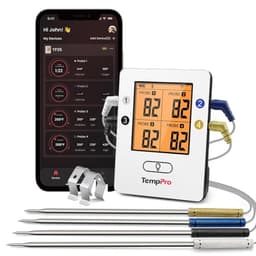
TempPro TempSync PRO TP25 4-Probe Bluetooth Thermometer
Four probes and long-range Bluetooth: one in the breast, one in the thigh, one at grate level. That is the two-thermometer setup the USDA asks for, with a spare.
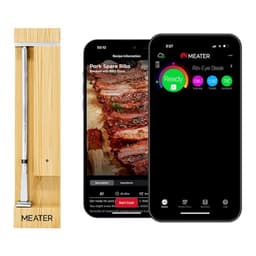
MEATER Pro Smart Meat Thermometer
A fully wireless leave-in probe with no cable through the lid gasket — the easier option if the bird is going to be moved, tented or carried indoors mid-cook.
$99.99 · View on AmazonPrice as of October 10, 2026. #ad How we’re funded
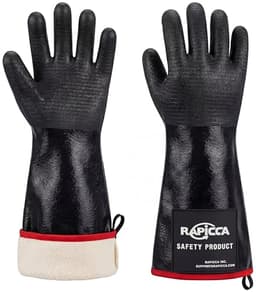
RAPICCA 14-Inch 932°F Heat-Resistant BBQ Gloves
Fourteen inches of 932°F-rated reach. Lifting a 14 lb bird off a grate is the single most dropped thing in barbecue, and short mitts are why.
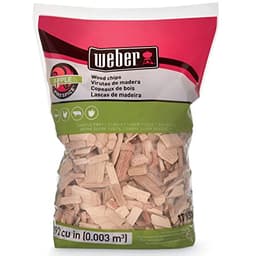
Weber Apple Wood Smoking Chips (2 lb)
Apple wood, in a 2 lb bag. Poultry takes smoke readily, so a mild fruit wood is a safer choice for a whole turkey than hickory or mesquite.
If this is the first long cook on a new smoker, read best smokers for beginners and best meat thermometers for smoking together — the thermometer matters more than the cooker. For the carving end of the job, best BBQ knives covers slicers and a boning knife for taking the bird apart.
Frequently asked questions
How long does it take to smoke a turkey?
Weber's figures are 23 to 27 minutes per pound at 225-250°F, 18 to 21 minutes per pound at 275-300°F, and 11 to 13 minutes per pound at 350-375°F, with about 3 minutes per pound added if the turkey starts out cold. For a 14 lb bird that is roughly 5½ to 6¼ hours at the low end and about 2½ to 3 hours at the high end.
What temperature should I smoke a turkey at?
The USDA gives 225 to 300°F as the smoking range. Around 275°F is the usual compromise: fast enough to keep the schedule sane and slow enough to take real smoke, with better skin than a 225°F cook produces.
What temperature is a smoked turkey done at?
165°F in the innermost part of the thigh and the thickest part of the breast, which is both Weber's instruction and the USDA's safe minimum for poultry. Check both places, because they do not finish at the same time.
How long should a smoked turkey rest?
Weber's guidance is 20 to 30% of the total cooking time, loosely covered with foil or left uncovered. On a five-hour cook that is around an hour — long enough to feel wrong, and exactly long enough for a bird that size.
Is pink meat near the bone a problem on smoked turkey?
Not by itself. The USDA is clear that color is not a reliable doneness test, and smoked poultry commonly stays pink near the bone at a safe temperature. The thermometer reading is the answer; the color is not.
Should you brine a turkey before smoking it?
It is optional and plenty of people swear by it. What matters more for a smoke is that the skin is dry when the bird goes on, so if you do brine, give it time uncovered in the fridge afterwards or pat it thoroughly dry.
Can you stuff a turkey you are going to smoke?
Better not to. Stuffing inside a bird at smoking temperatures takes a long time to come up to a safe temperature and makes every timing estimate unreliable. Cook the stuffing alongside instead.
What wood is best for smoking turkey?
A mild one. Poultry takes smoke very readily, so fruit woods like apple are a safer choice for a whole bird than hickory or mesquite, which can turn bitter over a five-hour cook.
Sources
- Weber — How Many Minutes Per Pound Will My Turkey Take? — 225-250°F: 23-27 minutes per pound; 275-300°F: 18-21 minutes per pound; 350-375°F: 11-13 minutes per pound; add about 3 minutes per pound if the turkey starts out cold; 165°F in the innermost thigh and the thickest part of the breast; rest for 20-30% of the total cooking time, foil optional (accessed October 11, 2026)
- USDA FSIS — Smoking Meat and Poultry — Keep the smoker or grill between 225 and 300°F, use two thermometers (food and smoker), and expect 4 to 8 hours (accessed September 18, 2026)
- USDA FSIS — Safe Minimum Internal Temperature Chart — The USDA's official safe minimum internal cooking temperatures for beef, poultry, pork and more (accessed July 21, 2026)
- USDA FSIS — Doneness Versus Safety — USDA on why color is not a reliable doneness test and a thermometer is (accessed July 21, 2026)
Keep reading
Best Meat Thermometers for Smoking
Two temperature channels, and how to read them from indoors.
See the thermometersHow to Smoke a Brisket
The other long cook, and the stall explained.
Read the guideHow to Grill a Whole Chicken
The same method on a smaller bird, in 90 minutes.
Read the guideGrilling in Cold Weather
Because November is when you will be doing this.
Read the guideBest Smoker Accessories
Smoke on any grill, plus the long-cook tools.
See the accessoriesHow Much Meat Per Person
What size bird to buy for the number of people coming.
Read the guide