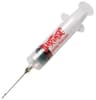
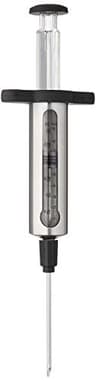
How we picked
Injectors are a category where the specs that matter are few and the marketing is loud. We ignored needle-count-as-a-number and the e-book bundles, and judged on four things:
- Barrel capacity. Nearly everything cheap is 2 oz, which is about 60 ml. On a whole turkey you will refill a 2 oz barrel several times; on a packer brisket, more. The two 50–70 ml SpitJacks exist for that reason alone.
- Needle variety, not needle count. One needle with a fine hole and one with large side holes cover thin marinades and thick ones. Four identical needles cover nothing extra.
- Whether it comes apart. An injector that cannot be stripped to barrel, plunger, O-ring and needle is an injector that will be thrown away. Cleaning brushes and spare O-rings in the box are a real signal.
- Honest fit to the job. Most people inject one turkey a year. We lead with the cheap options on purpose, and the expensive ones are labeled as what they are.
The published figures, side by side
Four of these six makers publish no spec sheet of their own, so the figures below are the ones on each maker’s own Amazon listing — which the copy on each card also states. Capacity is quoted in whichever unit the maker uses.
| Injector | Capacity | Needles | Case / extras | Action |
|---|
| Ofargo 304 stainless kit | 2 oz | 4 interchangeable | Brushes, spare O-rings, needle cleaners, manual | Plunger |
| Bayou Classic 5030 | 2 oz | 1 stainless | None | Plunger |
| Pit Boss 67287 | Not published | 1 stainless | None | Plunger |
| SpitJack SHOT XL MJ150 | 70 ml | 4 | Case, brushes, printed guide, recipes | Plunger, adjustable dose |
| SpitJack PULSE gun | 50 ml | 4 stainless | Case, guide | Trigger |
| SpitJack Magnum MJ106 | Not published on the listing | 4 | Case, brushes, guide; SpitJack states made in USA | Plunger |
Two of those cells are a maker not publishing a number rather than us hedging. Pit Boss puts no barrel capacity on its listing at all, and SpitJack does not state the Magnum’s on the retail page. We would rather print the gap than borrow a figure from a review site.
The food-safety rule nobody prints on the box
This is the part of the page worth reading even if you buy nothing. The USDA requires raw or partially cooked beef that has been needle-tenderized — which includes beef injected with a marinade or solution — to be labeled as mechanically tenderized, and to carry cooking instructions validated to destroy pathogens. The reasoning in the Federal Register final rule is that the process can move pathogens from the outside of the cut to the inside.
A home cook with an injector is doing the same thing in their own kitchen. The practical consequences:
- Cook injected beef through, not rare. A whole intact steak is safe seared rare because the interior was sterile. Once you have pushed a needle through it, that assumption is gone. The USDA’s figure for beef steaks and roasts is 145°F with a three-minute rest.
- Inject cold, and cook soon after. Do it straight out of the refrigerator, and get the meat on the heat rather than leaving it to sit on a counter while you find the grill lighter.
- Never re-use marinade that touched raw meat. The barrel and needle have been inside the cut. Mix what you need, use it, throw the rest.
- Clean it immediately. Marinade dries inside a needle in minutes and then it is permanent. This is the single reason injectors get thrown away.
None of that is an argument against injecting. It is an argument for owning a thermometer alongside the injector — see our thermometer roundup or, for long cooks, the smoking-specific one.
What to actually inject, and where
Turkey. The cut that benefits most, because the breast is the driest meat on a holiday table. Inject into the thickest part of each breast from several angles, plus the thighs, and keep the needle moving as you push so the liquid spreads rather than pooling. Our smoked turkey guide has the pit temperatures and the 165°F finish.
Pork butt. The most forgiving big cut in barbecue, and one where injecting mostly adds salt and moisture rather than rescuing anything. Worth doing for a crowd; skippable otherwise. The pork butt guide covers the wrap and the finish temperature.
Brisket. Where competition cooks use beef broth or a phosphate blend, and where a 2 oz barrel becomes genuinely annoying. If somebody smokes briskets regularly this is the case for the bigger barrel. The brisket guide has the stall and the wrap window.
What not to bother with. Chicken thighs, ribs, steaks under two inches, burgers, anything you are going to sauce heavily. The cut needs to be thick enough that the middle is a different place from the outside. If it is not, a rub does the whole job and a good rub is the cheaper present.
Buying this as a gift
An injector is a technique tool, which makes it a slightly awkward solo present: it implies a project. It works far better as half of something. Three pairings that land:
- Injector plus a rub. The recipe is half the gift. A sampler from the rubs and sauces page turns the tool into an afternoon.
- Injector plus a thermometer. For the reason in the safety section above, and because a probe is the single most useful thing a cook can be given.
- Injector plus smoking wood. Flavor in the middle and flavor on the outside. Our wood-chip roundup covers which wood goes on which bird.
If you are shopping for somebody who smokes rather than grills, gifts for meat smokers and smoker accessories are the wider lists this page feeds into.