How we picked
A metal skewer is a strip of steel with a point on it. There is almost nothing to get wrong, which is precisely why the listings compete on adjectives instead of numbers. We judged on five things a buyer can actually read off a page.
- Blade width. This is the anti-spin spec. A round skewer lets every piece of food pivot freely, so when you turn the skewer the food stays where gravity left it and one face never browns. A flat blade grips. Wider grips harder: the Brazilian-style pick publishes 0.4 inches, our main pick 0.32 inches, and everything else publishes nothing.
- Blade thickness. This is the stiffness spec, and it is the one nobody prints. Exactly one listing on this page gives a number — 0.18 mm — and even that is thin in absolute terms. A thin blade loaded with eight ounces of beef bows in the middle, and a bowed skewer sits on the grate unevenly, which is how you get one scorched side.
- Length, matched to the grill rather than maximized. Longer is not better. A skewer should be long enough that the handle end sits outside the lid line, so you can turn it without reaching over the fire, and short enough that it does not overhang the grate. Roughly: 17 inches for a 22-inch kettle or a three-burner gas grill, 14 inches for a portable grill, a tabletop griddle or an 18-inch kettle.
- What happens at the handle end. A bare steel handle conducts heat, so you are reaching for it with tongs or gloves either way. A wavy or looped steel handle gives you something to grip; a hardwood handle, as on the Brazilian-style pick, stays cool enough to hold. The trade-off is that wood cannot go in a dishwasher and will scorch if it sits over direct flame.
- Pack count and storage. Eight skewers feeds four people one round. Twelve to sixteen feeds a cookout. And a set that ships with tip covers and a bag survives a kitchen drawer; a loose set of sharpened steel strips does not, and you will find them with your fingers one day.
The specs, as published
| Set | Length | Blade width | Thickness | Pack | Handle |
|---|
| JY COOKMENT JY-22 | 17 in | 0.32 in | 0.18 mm | 12 | Wavy steel |
| MOCUMEI TXD2493 | 14 in | Not published | Not published | 16 | Steel |
| LANNEY | 17 in + two at 14 in | Not published | Not published | 12 | Steel |
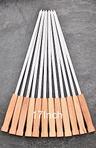
| HONSHEN Brazilian-style | 17 in overall (12.5 in blade) | 0.4 in | Not published | 12 | Hardwood, 4.5 in |
| FLAFSTER KITCHEN | 16 in | Not published | Not published | 8 | Steel, with push bar |
| Esie Houzie rack | Spans 8–16 in | n/a — holder | Not published | 2 stands + bars | n/a |
Read the “not published” cells as information rather than as a gap in our research. Four of these makers choose not to state a blade width and five choose not to state a thickness, and a buyer should price that uncertainty in. It is also why the two sets that do publish numbers take the top slots.
Flat versus round, and what actually happens on the grate
The flat-blade argument is real, and it is simple physics. A cube of chicken on a round skewer is a bearing: the skewer can turn inside the hole it made without the food turning with it. Flip that skewer and the raw side is still facing up. A flat blade cannot rotate inside the hole it cut, so the food goes where the skewer goes.
That is the whole case, and it is why every set here is flat. What varies is howmuchflat you get. A narrow flat blade still lets soft food — a mushroom, a cherry tomato, a piece of zucchini — tear its own slot and start spinning. A 0.4 inch blade will not. If the cooking is mostly vegetables and shrimp rather than beef, the wider blade is worth more than the extra few dollars it costs.
The honest limit on the whole category: no flat skewer stops food spinning if the pieces are cut too large or threaded too loosely. Two skewers through one row of food — a trick from Brazilian steakhouses — beats any single blade on the market and costs nothing.
Steel grade: the spec that is almost always missing
One set on this page names its alloy. FLAFSTER states 304 stainless and goes out of its way to say that cheaper skewers use 430 — which is an interesting claim to make in public, because 430 is a perfectly legal food-contact stainless that is simply less corrosion-resistant and is magnetic. Every other set here says “food grade stainless steel” and leaves it there.
Practically: a 430 skewer that gets washed and dried will last years. A 430 skewer left wet in a drawer with salt on it will eventually show rust spots along the edges. If someone in the house is going to put the skewers away damp, pay for the named alloy. If they go in the dishwasher and come out dry, it does not matter much, and we would rather have the published blade width than an unverifiable grade claim.
Why kabobs stick, and what the rack is really for
People blame their skewers for food tearing in half when they turn it. The cause is usually the grate: protein welds itself to hot steel bars within seconds, so the underside of each cube is glued down while the top is still cooking, and turning the skewer rips it.
A kabob rack solves the problem structurally by holding the skewers an inch or so above the bars so the food never touches them. The Esie Houzie set publishes the details that make a rack work rather than wobble: a stabilizer bar that locks the two stands together, so turning a loaded skewer does not tip the whole thing over, and an extension bar that sets the span anywhere from 8 to 16 inches so it fits skewers you already own. Twelve step-down notches across two heights hold a flat skewer either flat or on edge, which is how you cook all four faces of a cube evenly.
The trade-off is that food lifted off the grate gets no grate marks and less direct char. For vegetables and shrimp that is a win. For beef that someone wants crusted, use the rack for the slow part and drop the skewers onto the bars for the last two minutes.
Loading a skewer so it cooks evenly
- One ingredient per skewer, not a rainbow. Chicken, peppers and zucchini need different times. The photogenic alternating kabob guarantees that something is raw or something is mush. Cook them on separate skewers and assemble on the plate.
- Cut to the same size, roughly 1 to 1.5 inches. Uniformity does more for evenness than any gear on this page.
- Leave a little air between pieces. Packed tight, the sides steam instead of browning. A gap the width of a pencil is enough.
- Thread through the widest axis. A shrimp skewered through both the tail and the body cannot curl off; a mushroom through the stem and cap cannot split.
- Oil the food, not the grate. A thin film on the meat releases far better than oil burned onto bars — and see our grill brush guide if the bars are already carrying last month’s dinner.
Times and temperatures that are not ours
Skewers are direct-heat cooking, and the specifics depend entirely on what is on them. Weber’s own shrimp kabob recipe is a useful calibration point: extra large shrimp over direct high heat at 450–550°F, lid closed, 2 to 4 minutes total, turning once, until the surface is firm and the center is opaque. That is the whole cook — shrimp on a skewer is a four-minute job, and almost everybody overcooks it.
Chicken is the opposite problem. Cubes cook fast on the outside and the USDA finish line is 165°F throughout, so the temptation is to pull them early because they look done. Use a thermometer in the thickest cube rather than guessing — our thermometer guide covers where to put the probe — and remember that color is not a doneness test. Beef cubes follow steak rules and come down to preference, not safety.
If you are using bamboo instead of metal, Weber’s instruction is to soak the skewers for 30 minutes first so the exposed ends do not burn through. That soak is the reason metal skewers exist: it is the step everyone forgets at 6pm on a Saturday.
Buying skewers as a gift
Skewers are a small, safe, genuinely useful present, and unlike most grill gear they do not depend on knowing which grill someone owns.
- They are a pairing gift, not a headline. A set of skewers alone is a slightly thin present. With a rub or a sauce and a decent set of tongs it reads as a complete kit. See grilling gifts under $25 for pairings at this price.
- The Brazilian-style set is the one that looks like a present. Hardwood handles and a wide blade photograph like steakhouse equipment, which matters when the thing has to be unwrapped in front of people.
- The push-bar set is the one for someone who entertains. It comes in a gift box with a bag, and the push bar is the kind of detail a host who serves twelve kabobs at once will actually mention to you afterwards.
- Buy the 14-inch set for a balcony or a camper. Long skewers on a small grill are a daily irritation. If they cook on a portable, the short sixteen-pack is the right answer — and gifts for apartment grillers is built around that constraint.
And the honest case for buying nothing: if they already own twelve good flat skewers, a second set is clutter. Buy the rack instead. It is the part of this category nobody owns and the part that fixes the thing they actually complain about.