What a kamado is actually selling
Three things, and it is worth separating them because different alternatives replace different ones.
- Insulation. Thick ceramic holds heat, which is why a kamado can run an overnight cook on one load of fuel and recover quickly when the dome opens. This is the hardest property to replace cheaply, and the only pick here that genuinely attacks it is the AKORN’s triple-walled steel body.
- Range on a single load. Kamado Joe publishes 225–750°F, which means one cooker both smokes and sears. Char-Griller publishes 200–700°F for the AKORN, which is the same claim fifty degrees lower. A kettle will reach searing heat happily; what it will not do is hold 225°F for twelve hours without attention.
- Depth rather than width. The Classic II is only 250 sq in of primary surface — it is a deep cooker, not a wide one, and the Divide & Conquer racks are how it gets capacity back. If what you actually want is grate area, almost every alternative here beats it: 325 sq in primary on the AKORN, 443 sq in total on the Master-Touch, 363 sq in on the Original Kettle.
The five, measured against the original
| Cooker | Published range | Published area | Weight | What it drops |
|---|
| Kamado Joe Classic Joe II (the original) | 225–750°F on one load | 250 sq in primary, 2-tier racks | 227.7 lb | — |
| Char-Griller AKORN | 200–700°F | 445 sq in total, 325 primary | 88.2 lb on casters | Ceramic, the lifetime body warranty, and overnight fuel capacity (3.1 lb max load) |
| Weber Master-Touch 22 | Not published as a range | 443 sq in incl. 80 sq in warming rack | Not published on this listing | Insulation entirely - it is a single-wall kettle |
| Pit Boss 500 FB2 | 180–500°F in 5°F steps; lever rated to 1,000°F | 518 sq in, two tiers | Not published on this listing | Charcoal itself - it burns pellets and needs an outlet |
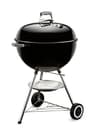
| Weber Original Kettle 22 | Not published as a range | 363 sq in | Not published on this listing | Insulation, a lid thermometer and a hinged grate |
| Slow ’N Sear 22 insert | n/a - it is an insert | Leaves about two thirds of the grate indirect | n/a | Everything except the fuel bed - you supply the kettle |
Blank cells are blank because the maker does not publish that figure on the listing we read. Weber publishes grate area and warranty rather than a temperature range for its kettles, which is a reasonable thing for a charcoal grill maker to do — the range depends on the fuel and the vents, not on the grill.
If what you want is heat retention
Buy the AKORN. A triple-walled insulated steel body is the only thing on this page that attacks the ceramic’s core advantage, and the published 200–700°F range says Char-Griller believes it works for both searing and smoking. It is also the pick with the clearest published limits: a 3.1 lb maximum charcoal load, which caps a genuinely long overnight cook; a steel body that can dent and chip where ceramic would not; a 5-year warranty against the lifetime cover the ceramic makers put on their bodies; and 46 inches wide by 31 deep assembled, so measure first.
That charcoal-load figure is the honest reason the AKORN is not simply “a cheaper Kamado Joe”. A ceramic cooker’s party trick is a fourteen-hour brisket on one basket of lump. The AKORN will do a long cook; it will not do that one without a refuel.
If what you want is a better charcoal grill
Then a kamado was never the right answer and the Master-Touch is. Weber publishes 443 sq in including an 80 sq in warming rack, a cooking grate that flips up on two sides so fuel goes in without moving food, two char-rails that hold the coals to one side for genuine two-zone cooking, a Tuck-Away lid holder and a built-in lid thermometer. That is more usable grate than a Classic Joe and a far more convenient grill for weeknight cooking.
The Original Kettle 22is the same bowl and lid for less: 363 sq in, One-Touch ash cleaning, and Weber’s published 10 years on the bowl and lid against rust-through and burn-through. It drops the lid thermometer, the hinged grate and the enclosed ash catcher. Either of them, plus the Slow ’N Sear insert, gets you remarkably close to kamado behaviour for a fifth of the money — see kamado versus kettle for the longer version of that argument.
If what you wanted was not to tend a fire
A lot of kamado interest is really interest in walking away from the cooker. If that is the actual motivation, charcoal is the wrong fuel and the Pit Boss 500 FB2 is the honest answer: 518 sq in across two tiers, 180–500°F set in 5°F steps from a digital controller, a Flame Broiler lever that opens the fire pot for direct-flame searing Pit Boss rates to 1,000°F, two probe ports with one probe included, and a 5-year warranty. It needs an outlet and a 5 lb hopper means topping up on a long cook.
What it will not give you is charcoal flavour, and nobody should pretend otherwise. Charcoal versus pellet is the trade in full.
One safety point that applies to all of them
Ceramic and insulated cookers run hotter and hold heat far longer than people expect, and the makers are explicit about how to light them. Big Green Egg’s own safety guidance is to avoid lighter fluid or any flammable liquid in the cooker and to use fire starters instead — advice that applies equally to the AKORN, to a kettle, and to anything else that holds heat in a closed dome. A chimney starter and lump charcoal are the standard answer, and they cost very little next to any cooker on this page.