How we judged them
Four criteria, applied in this order. Everything else about a bag of pellets is packaging.
- What wood is actually in it. A bag labeled hickory is not necessarily hickory. Kingsford is unusually straight about this and publishes that its hickory Craftsmoke bag is a hickory and oak blend. Most makers do not say, which is a fact about the bag worth knowing before you pay a premium for a flavor name.
- What else is in it. Camp Chef publishes 100% virgin hardwood with no oils, chemicals or binders, and says it uses hardwood rather than byproduct. Bear Mountain publishes no flavorings, fillers or additives. Traeger publishes no binders. A bag that says nothing on this point has told you something.
- Bag weight, then price per pound. The standard used to be 20 lb and Traeger’s bags are now 18. That is a 10% price rise nobody announced, and it is why the value pick here is a full-size bag from somebody else.
- Whether the flavor matches the food. Mesquite on fish is a waste of a fish. Apple on brisket is a waste of a brisket. We matched every bag to what it is actually for rather than ranking them against each other in a line.
The published figures, side by side
Every cell below is the maker’s own. Empty-sounding cells are not laziness - they are what happens when you only print what a manufacturer will actually commit to.
| Bag | Weight | Wood | Additives claim | BTU / ash / moisture |
|---|
| Traeger Signature Blend | 18 lb | Hickory, maple, cherry | All-natural, no binders, low ash | Not published |
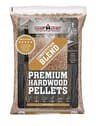
| Camp Chef Competition Blend | 20 lb | Maple, hickory, cherry | 100% virgin hardwood; no oils, chemicals or binders | Kiln-dried, low moisture; no figure published |
| Kingsford Craftsmoke Hickory | 20 lb | Hickory and oak blend | No fillers, no oils, no additives | Not published |
| Traeger Apple | 18 lb | Apple | All-natural, no binders, low ash | Not published |
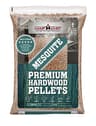
| Camp Chef Southwest Mesquite | 20 lb | Mesquite | No oils, chemicals or binders | Kiln-dried; no figure published |
| Bear Mountain Gourmet Blend | 20 lb | Not published (house blend) | 100% hardwood; no flavorings, fillers or additives | Low moisture claimed; no figure published |
| BBQr’s Delight Super Smoker pack | 6 x 1 lb | Apple, hickory, mesquite, cherry, pecan, sugar maple | Not published | Maker rates ~10 uses per bag at 1/3 cup each |
Four of the seven makers publish no BTU figure, no ash percentage and no moisture content. Several advertise “low ash” without ever printing a number for it. Treat that phrase as a direction of travel rather than a measurement, because that is all anybody has given you to go on.
Which wood for which food
This is the part that actually changes dinner, and it is simpler than the shelf makes it look. Woods sit on a line from mild to loud, and the rule is to match the volume of the wood to the volume of the food.
- Apple and cherry (mild, sweet). Pork shoulder, ribs, chicken, turkey, fish, anything baked. Very hard to overdo over a long cook. If somebody has ruined poultry with too much smoke once, this is the fix.
- Maple and pecan (mild-medium, sweet and nutty). Pork and poultry again, plus vegetables and cheese. The quiet middle of the range.
- Oak (medium, clean). The workhorse of Texas barbecue and the wood that disappears into the background in a blend. It is why a hickory-and-oak bag is usually more pleasant than pure hickory.
- Hickory (strong, bacon-like). Pork, beef, ribs. The classic barbecue smell. On a chicken breast or a fish fillet it bullies the food.
- Mesquite (loudest). Beef, specifically - brisket, steak, fajitas. Over a long cook it can turn harsh, which is why plenty of Texas cooks use it for the sear and oak for the hours.
Blends exist to sit in the middle of that list so one bag covers a season, which is exactly why a blend is the right gift when you do not know the cook. A single-species bag is the right gift when you do.
Three things that are true of every bag
Pellets are not brand-locked. Any food-grade hardwood pellet runs in any pellet grill. Kingsford names Traeger, Pit Boss, Green Mountain, Camp Chef and RecTeq on its own listing. The only pellets to keep out of a grill are heating pellets, which are not food-grade and are sold for stoves.
Moisture is the enemy, and storage is free. A pellet is sawdust held together by the wood’s own lignin under pressure. Let it get damp and it swells, crumbles and jams the auger - the single most common pellet-grill fault there is. Pellets belong in a sealed bucket or bin, not in an open bag on a garage floor. That is also why every maker on this page advertises low moisture content: dry pellets burn hotter and leave less ash.
A bag of fuel is not a present on its own. It is a refill. Pair it with something - a decent thermometer, a cover or a pair of gloves - and it becomes a gift that happens to include the thing they were going to buy anyway.
If they do not own a pellet grill
Pellets are not only for pellet grills, and this is the most useful thing on the page for a gift buyer on a budget. A pellet tube is a perforated steel tube you fill with pellets, light at one end and lay on the grate of a gas or charcoal grill; it smolders for hours and turns an ordinary grill into a smoker for the price of a takeaway. The LIZZQ pellet tube review covers how that works, and pellet tube vs smoker box compares it with the other cheap route. A tube wants exactly the quantity the BBQr’s Delight sampler comes in, which is why those two go in the same box.
If the gift is the cooker rather than the fuel, best pellet grills is the page for that, and best electric smokers covers the other plug-in-and-walk-away route - those cabinets burn chips rather than pellets, so this page is not the fuel for them.