What you’re actually buying
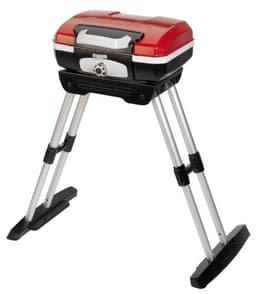
A single-burner propane grill rated at 13,000 BTU over 320 square inches of porcelain-enameled, cast iron cooking grates. Weber puts the capacity at twelve burgers or fifteen sausages and says it feeds up to four people. It runs off a disposable propane cylinder, carries a built-in lid thermometer and one side table, and sits on a folding frame with wheels.
The grate material is the story, and it is the same reason the Q 1200 earned its reputation. Cast iron holds heat instead of shedding it, so the grill recovers quickly when the lid comes up and cold food goes on — and that recovery is where grill marks and browning come from. Thin steel grates on cheaper portables simply cannot do this, and it is the single biggest difference in the food.
The frame is the part the Q 1200 never had. Weber’s own description is “easy to raise and lower with 1 hand, simply press the lever,” and the lid locks itself when it folds down — so the thing that gets loaded into a car is a closed unit on wheels rather than a tabletop box that needs both arms and a free surface at the other end.
How it compares to the Q1200
On paper the Traveler is the bigger grill in every dimension that matters: 13,000 BTU against 8,500, 320 square inches against 189, twelve burgers against six. It is also much heavier — 49 pounds against 31 — but it rolls, which settles some of that difference in practice.
What the two share is the part worth paying for. Both use porcelain-enameled cast iron grates and a single stainless burner under a lid, and both run off a disposable propane cylinder. The Q 1200’s advantage is that it is a genuine tabletop grill and lighter to lift onto one; the Traveler’s is that it brings its own legs, feeds twice as many, and is actually in stock.
The single-burner question
This is the specification people worry about, and the concern is half right. One burner means one heat setting across the whole cooking surface, so you cannot run a hot side and a cool side the way a multi-burner grill can.
In practice, the lid and the cast iron mitigate it more than the spec sheet suggests. With the lid down the grill works as a convection oven, so bone-in chicken and thicker cuts can cook through on a moderate setting rather than burning on the outside — and the built-in lid thermometer makes that a decision rather than a guess. It is not a true two-zone setup — our direct versus indirect guide explains what you give up — but it is far from the “thin food only” limitation of a cheap tabletop grill.
Where it falls short
Cylinders are a running cost and a running annoyance. Weber lists the disposable propane cylinder as sold separately, and disposables are not cheap — they also run out mid-cook if nobody is keeping count. Weber’s 6501 adapter hose connects the grill to a standard 20 lb tank and removes the problem entirely, but it is a separate purchase and it tethers the grill to something the size of a bin.
It is 49 pounds, and 40 inches wide. The wheels do the work on flat ground, and Weber’s listing puts it in the back of most SUVs — but getting it in and out is still a two-handed lift, and a small hatchback boot is not the brief. This is a car-to-campsite portable, not a walk-to-the-park one.
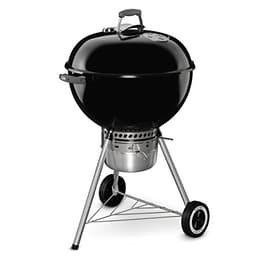
It costs a lot for the cooking area. A charcoal kettle at the same money cooks for twice as many people. You are paying for convenience and build quality, not for capacity — that comparison is worked through in charcoal kettle vs portable gas.
One side table, not two. There is somewhere to put the tongs or somewhere to put the plate, but not both at once. It is a small thing that becomes a real thing on a balcony with no other surface.
Who this is the right gift for
Someone in a small space who is allowed propane. This is the grill that makes a small patio into a working outdoor kitchen and then folds down out of the way, without the ash problem that gets charcoal banned in so many buildings. Measure first if it is going on a balcony — folded, it is still 43.6 inches wide. See gifts for apartment grillers for the rules worth checking first.
It is also the right gift for someone who cooks away from home regularly — camping, tailgating, a boat, a caravan; Weber pitches it as trail-to-tailgate, and that is exactly the job. And it is a good second grill for a household that already owns charcoal but wants something for weeknights, when nobody has half an hour to spare.
Who should get something else
Anyone who hosts. Weber’s own figure is four people, and twelve burgers in a sitting is a family dinner rather than a party. For a household that regularly feeds eight, a full-size grill is the honest answer — see best grills for beginners.
And anyone who specifically wants charcoal flavor. If the person you are buying for talks about the taste of charcoal, giving them a gas grill is a statement about their preferences that will not be received the way you intend.
What to give alongside it
Cast iron grates want a bristle-free brush, because porcelain enamel chips under hard steel wire and chips are where rust starts. A spare cylinder or two removes the most predictable annoyance. And a thermometer matters more on a single-burner grill than on most, because there is no cool zone to retreat to if something is running ahead of schedule.
The obvious alternative is not another Weber at all: a three-burner folding Coleman gives two-zone cooking that a single-burner grill cannot. Weber Traveler vs Coleman RoadTrip 285 puts them side by side on published figures.