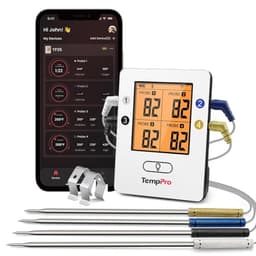
What TempPro actually publishes
This is a cheap thermometer with an unusually complete spec sheet, which is the first point in its favor. Most fifteen-dollar probes publish a response time and nothing else.
| Spec | Published figure |
|---|
| Response time | 1 second |
| Accuracy | ±0.9°F (±0.5°C) |
| Range | −58 to 572°F (−50 to 300°C) |
| Probe | 304 stainless steel, 4 in (103 mm) |
| Water resistance | IP65 |
| Display | Backlit LCD, 180° auto-rotating |
| Power | 1 x AAA, rated up to 3,000 hours of use |
| Calibration | User calibratable |
| Warranty | 3 years after registration |
The maker’s listing adds one more claim worth noting: it is described as NSF Certified, which is a commercial food-service certification rather than a consumer marketing badge.
Two small conflicts between the spec page and the listing
We check both, and on this product they do not quite agree. TempPro’s product page gives a 4 in (103 mm) probe; the Amazon listing says 4.3 inches. The product page gives a display of 1.75 in by 0.75 in; the listing calls it a 2.0-inch display.
Neither gap changes whether you should buy it — a third of an inch of probe is not a decision — but we would rather print the disagreement than quietly pick the flattering number. Where two sources differ on this site, you get both.
About that one-second reading
TempPro publishes a one-second response time. Across the rest of this site we describe the TP19H as a roughly three-second read, and that is deliberate: a manufacturer’s response figure describes how fast the sensor itself reacts under ideal conditions, not how long it takes you to find the center of a chicken thigh and watch the number settle.
The practical difference between a one-second thermometer and a three-second one is nothing. The meaningful difference is between any fast digital probe and the dial thermometer that came with the grill, which can take half a minute to settle and is often wrong anyway. That is the gap this fifteen-dollar tool closes.
What IP65 does and does not cover
IP65 means protected against dust and against low-pressure water jets from any direction. In kitchen terms: you can rinse it under a running tap and wipe it dry, which matters because a thermometer that has been in raw chicken needs cleaning properly and a non-waterproof one gets cleaned badly.
What IP65 does not mean is submersion. It is not rated for being dropped into a bowl of brine or left in a sink of washing-up water, and the battery compartment is the part that will remind you of that. “Rinse, don’t soak” is the rule.
Is ±0.9°F accurate enough?
Comfortably, for everything a griller does. The USDA’s safe minimum internal temperatures are the numbers that actually matter — 165°F for poultry, 145°F for whole cuts of beef, pork, lamb and fish with a three-minute rest, 160°F for ground meats — and a thermometer within a degree of true tells you whether you have reached them.
It matters more that the reading is taken in the right place than that the device is accurate to a tenth of a degree. The thickest part of the cut, away from bone, and a second check somewhere else to confirm it. The USDA is also explicit that color is not a reliable test of doneness, which is the reason this thermometer belongs in the hands of anybody still cutting into a chicken breast to look at it.
The sleep-wake trick, and why it is more than a gimmick
The listing describes motion-sensing sleep and wake: the thermometer powers on when the probe is folded out and off when it is folded back, and wakes when it is picked up. On a cheap tool that behavior is worth more than it sounds, because the leading cause of death for a budget instant-read is a flat battery discovered at the moment you need it.
A single AAA rated for up to 3,000 hours of use, plus a device that genuinely switches itself off, is the difference between a thermometer that works in May and one that works in October. The 180° auto-rotating display is the other small kindness: you can read it upside down or in either hand without rotating your wrist over an open fire.
What it cannot do
It is a single-probe spot checker, so it checks one piece of meat at a time, and it is not a leave-in probe. You cannot shut the lid on it, you cannot watch a brisket climb through the stall from the kitchen, and you cannot track grate temperature and meat temperature at once.
That is the honest boundary of the product rather than a flaw in it. The moment someone starts doing long cooks they want a second, different tool — a leave-in probe or a multi-probe base — and the two kinds live side by side rather than replacing each other. We set that out in full in instant-read vs wireless thermometer.
Calibration and the warranty nobody claims
Two features here are unusual at this price. The first is that it is user calibratable: if an ice-water check reads a degree or two off, you can correct it rather than live with it. The second is the three-year warranty, which TempPro states applies after registration — a condition worth reading, because a warranty you never registered for is a warranty you do not have.
If you are giving this as a gift, that is the one thing worth mentioning in the card. Nobody registers a fifteen-dollar thermometer, and this is the rare one where it is actually worth two minutes.
As a gift
This is the best cheap grilling gift there is, and it works for an almost absurd range of recipients: the beginner who overcooks everything, the person who has just been given a grill, the keen cook who somehow still owns no thermometer. It is small enough to be a stocking filler and useful enough not to feel like one.
Its one weakness as a present is that it is not exciting to unwrap. The fix is pairing: a thermometer with a pair of heat gloves, or with a bag from the charcoal guide, is a complete and genuinely thoughtful gift for well under fifty dollars. It also sits at the center of every list in gifts under $25 for the same reason: nothing else that cheap changes the food as much.