How we set the band
By reading our live price layer. Four registry portables carried a buyable price under a hundred dollars when this page was built, and all four are here. The next portables up — the Weber Q 1200N, the Coleman RoadTrip 285 and the Weber Traveler — are all comfortably above the band, and all three are gas, which is the clearest possible illustration of what this hundred-dollar ceiling actually selects for.
How we picked
- Whether it can run two zones. On charcoal this is free: you pile the coals on one side. The Jumbo Joe has enough depth to do it properly, the Go-Anywhere is shallower so there is less room for indirect cooking, and the Smokey Joe is 14 inches of bowl. The single-burner gas pick cannot do it at all.
- How it carries, specifically. “Portable” covers a one-handed carry to a balcony and a two-handed lift into a trunk. The Go-Anywhere’s legs fold over the lid so it behaves like a case, the Smokey Joe goes one-handed, and the Jumbo Joe is a two-hands job with a lid lock. None of these has a stand, so they need a table or the ground.
- Grate shape, not just area. A rectangular grate like the Go-Anywhere’s fits sausages, corn and skewers in a way a small round one does not. This sounds trivial until you have tried to fit six brats on a 14-inch circle.
- The build underneath the price. All three charcoal picks are genuine Weber porcelain-enameled bowls and lids — the same finish as the full-size kettles — which is why they survive being left outside in a way that a stamped-steel portable does not.
- What the fuel costs to keep using. Charcoal is cheap and available everywhere. The 1 lb propane canisters the gas pick uses are a per-trip cost, and a grill that needs a canister you forgot to buy is a grill that does not work.
The four at a glance
| Pick | Fuel | Size | Two zones? | How it carries |
|---|
| Weber Jumbo Joe | Charcoal | 18 in grate | Yes - enough depth to bank coals | Two hands; lid lock |
| Weber Go-Anywhere | Charcoal | Rectangular grate | Limited - shallower than a kettle | Legs fold over the lid, carries like a case |
| Char-Broil Portable Convective | 1 lb propane canister | Not published on this listing | No - one burner, one zone | Tabletop |
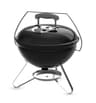
| Weber Smokey Joe | Charcoal | 14 in grate | Barely - cooks for two or three | One hand |
Every figure there is the maker’s own. Char-Broil publishes no cooking area on the portable’s listing, so that cell stays empty rather than getting a number from somewhere else.
Why three of four are charcoal
Because of what a hundred dollars is enough for in each fuel. A charcoal portable is a bowl, a lid, a grate and some vents — there is nothing in it to go wrong, so the money goes into the enamel and the hardware. A gas grill at the same price has to include a burner, a regulator, an igniter and a valve, so something has to give, and what gives is burner count and build.
The practical consequence is a real trade rather than a verdict. Charcoal gives you better food for less money and a two-zone fire for free; it costs you twenty minutes of lighting time and leaves you with hot coals to deal with before you drive home. Gas gives you a cook that starts five minutes after you arrive and nothing to dispose of; under a hundred dollars it costs you heat control. Our gas versus charcoal guide is the longer version of this, and a chimney starter is what removes most of the charcoal objection — it is the cheapest upgrade in grilling.
Who each one is actually for
- Balcony or a very small patio: Smokey Joe, if charcoal is allowed, or the Char-Broil if it is not. Check the lease first — our apartment grilling page starts there, because a banned grill is the only real failure mode.
- Camping with a picnic table: Go-Anywhere. The folding legs and the rectangular grate are both specifically good at this, and there is no stand to pack.
- Tailgating for a group: Jumbo Joe for the capacity, with the caveat that hot coals in a parking lot need a plan. If that plan does not exist, gas is the right fuel and the portable gas page is the right page.
- A first grill, not just a travel grill: Jumbo Joe. An 18-inch grate with real indirect capability is a grill you can learn on, and our beginners page explains why indirect heat is the skill that matters most.
What a hundred dollars does not buy
A stand, on any of these. A lid thermometer or an ash catcher on the Smokey Joe. A second burner on the gas pick. And nothing here is a smoker — a portable can hold an indirect zone for an hour or two, but a 14 or 18-inch bowl does not have the fuel capacity for a long cook. If low-and-slow is the goal, the money is better spent on a full-size charcoal grill than on a portable at any price in this band.