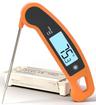
What the Thermapen is actually known for
Three things, and it is worth separating them, because most alternatives match one or two and almost none match all three.
- Speed. ThermoWorks publishes a full reading in one second or less. That matters less for safety than it sounds and more for behavior than people admit: a one-second read means you check four pieces of chicken instead of one, with the lid open for four seconds instead of thirty.
- Provable accuracy. Plus or minus 0.5°F is a good number, but the part that is hard to copy is the NIST-traceable certificate from an A2LA-accredited lab in every box. That is a claim about this individual unit, not about the model, and it is the reason professional kitchens buy them.
- Durability and backing. IP67 and a five-year warranty — ThermoWorks’ own comparison page notes the ONE raised that from the Classic Thermapen’s two years, and that the ONE is waterproof where the Classic was only splash-proof. Nothing else on this page publishes a warranty length at all.
Note the accuracy spec in full, because it is the detail everyone shortens: ThermoWorks states plus or minus 0.5°F from −4 to 248°F, and plus or minus 1.8°F outside that band, out to −58 and 572°F. Every temperature that matters for cooking meat sits inside the tight band, which is exactly how a spec sheet should be written.
How we picked the alternatives
We judged every candidate on the five things the Thermapen publishes, and we treated a missing number as a missing number rather than as a pass.
- Published read time. Three of our picks publish 0.5 seconds, which is faster than the Thermapen’s published one second. Treat that with mild skepticism — read-time claims are measured differently by different makers and nobody publishes the method — but it is a published figure and we are not going to pretend it is not there.
- Published accuracy, and whether a certificate comes with it. This is the real separator. “NIST-certified plus or minus 0.5°F” (Typhur, ThermoMaven) is a different and stronger claim than “plus or minus 0.5°F achievable via laboratory calibration” (Lavatools’ own wording), which is in turn stronger than a bare accuracy number with nothing behind it.
- IP rating, stated as a rating. IP67 means it survives immersion; IP65 means it survives spray. “Waterproof” with no number means nothing. A thermometer that has been in raw chicken needs washing, not wiping, so this matters more in this category than in most.
- The display, for the way people actually hold it. An auto-rotating backlit screen is not a luxury on a grill: you read it left-handed, upside down, in the dark, at arm’s length over heat. Every pick here has one. One pick (Typhur) uses an LED rather than an LCD and states that it is readable in direct sunlight, which is the one condition where an LCD genuinely struggles.
- Who sells it, and whether a warranty exists. Only ThermoWorks publishes a warranty length among everything here. Two of our picks ship from third-party storefronts rather than from Amazon or the brand, and the cards say so. On a $30 thermometer that matters less than on a $230 prep table, but it is still the difference between a replacement and an argument.
The six against the original
| Thermometer | Published read | Published accuracy | Certificate | Water rating | Warranty |
|---|
| Thermapen ONE (the original) | 1 sec or less | ±0.5°F, −4 to 248°F | NIST-traceable, A2LA lab | IP67 | 5 years |
| Lavatools Javelin PRO Classic | 2–3 sec | ±0.5°F via lab calibration | Not included | IP65 | Not published |
| Typhur InstaProbe Core | 0.5 sec | ±0.5°F, NIST-certified | NIST-certified (per listing) | IP67 | Not published |
| ThermoMaven 0.5 Sec | 0.5 sec | ±0.5°F, NIST-certified | NIST-certified (per listing) | IP67 | Not published |
| ThermoWorks ThermoPop 2 | 2–3 sec | ±1°F | NIST-traceable, in the box | IP67 | Not published on this listing |
| TempPro TempSwift TP19H | 1 sec (listing title) | Not published as a tolerance | None | Waterproof, no rating published | Not published |
| KIZEN instant-read | Not stated on the listing | Not published as a tolerance | None | IP67 | Not published |
Two notes on that table before you read anything into it. The TempPro listing’s own title now claims a one-second read, which would put it level with the Thermapen on the one spec it cannot possibly match for the money — it publishes no accuracy tolerance, no certificate and no IP rating, so treat the speed claim as a title rather than a specification. And “not published” in the warranty column is not a trick: outside ThermoWorks, nothing on this page states a warranty length at all.
Read the table as a map of what you give up, in this order: the certificate goes first, then the warranty, then the IP rating, then accuracy, then speed. The cheapest picks have given up everything except the thing that matters most — being in your hand when the chicken is nearly done.
Does the accuracy difference actually change the cooking?
Mostly no, and it is worth being straight about that rather than selling a spec. The USDA’s safe minimum internal temperatures are whole numbers with real margin built in — 165°F for poultry, 145°F plus a three-minute rest for whole cuts of pork, beef, lamb and veal, 160°F for ground beef — and the difference between a thermometer that is accurate to half a degree and one accurate to two degrees does not change whether you clear those numbers. The USDA’s own position is the one that matters here: color is not a reliable doneness test, and a thermometer is. Any thermometer on this page is enormously better than no thermometer.
Where accuracy and speed do change things is at the narrow end: a medium-rare steak has maybe a six-degree window, a cook pulling tuna or chicken breast to the edge of safe has less, and a slow reading taken through an open lid costs you grill temperature while you wait. That is the case for spending more, and it is a real one. It is not a food-safety case.
If you want the whole set of numbers rather than a thermometer recommendation, our grilling temperature chart has the USDA figures in one place.
What a Thermapen alternative is not
A fast instant-read and a leave-in probe are different tools, and the single most common mistake in this category is buying one expecting the other.
- A wireless probe is not a Thermapen alternative. A MEATER or an INKBIRD lives in the meat for hours and tells you when to pull it. An instant-read tells you what the temperature is right now, anywhere you poke. Most serious cooks end up with both. If the wireless kind is what you actually want, we have a separate page of MEATER alternatives and a roundup of wireless meat thermometers.
- A surface thermometer is a third thing again. Autocomplete sends people looking for a “pro surface Thermapen alternative” — that is a griddle and pan-surface instrument, not a probe, and nothing on this page replaces it. If the cooker is a flat top, the temperature you care about is the plate, not the middle of the food.
- A cheap instant-read is not a cheap Thermapen. The sub-$15 picks here are genuinely useful and we recommend them; they are not the same object with a different sticker. What you are buying at that price is a thermometer, not a calibrated instrument, and the listings say nothing about tolerance for a reason.
Which one to actually buy
If you cook often and want one good tool: the Lavatools Javelin PRO Classic. It is the one that gives up the least across the whole spec sheet and it has the longest independent track record of anything here.
If you are spec-driven and the price is the only objection: the Typhur InstaProbe Core, which publishes a faster read than the Thermapen, the same accuracy figure and the same IP67 rating — and which is still a young brand with no published warranty, which is the honest cost of that match.
If you want certification at the lowest possible price: the ThermoMaven. NIST-certified accuracy and IP67 for a fraction of the original, shipped by a marketplace storefront rather than by Amazon.
If the appeal was ThermoWorks all along: the ThermoPop 2. Same company, same certificate, same NSF mark, and honest about being slower and looser.
If this is a gift or a second thermometer for the kitchen drawer: the TempPro TP19H or the KIZEN. They are the two that turn “we should really check that” into checking it. And if you are buying for a griller generally rather than solving the thermometer question specifically, our best meat thermometers roundup covers instant-reads, leave-ins and wireless probes side by side, and best meat thermometers under $50 is the band most of this page sits in.